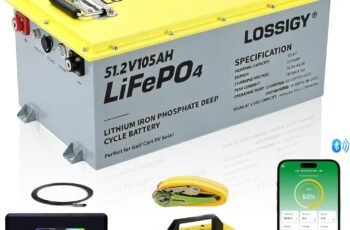
We find this 12.8V, 100Ah Group 24 LiFePO4 battery a versatile storage option for RVs, home backup, and off-grid systems. Its 150A BMS provides protection against overcurrent, short circuits, extreme temperatures, and other faults, while app monitoring shows key operating data. You can expand capacity by connecting up to 16 identical batteries. It isn’t designed for engine starting or golf carts, and loads must stay within its limits. Below, we outline its features, advantages, and precautions.
Key Takeaways
- This Group 24 battery provides 12.8V and 100Ah capacity, using Grade A LiFePO4 cells and a convenient carry handle.
- Its 150A BMS includes overcharge, over-discharge, overcurrent, short-circuit, temperature, and cell-balancing protections.
- App monitoring displays voltage, current, power, state of charge, and cycle count in real time.
- Up to 16 identical batteries can be configured in 4P4S, expanding capacity from 1.28kWh to 20.48kWh.
- It suits RVs, home backup, and off-grid systems, but not engine starting or golf carts; observe temperature and current limits.
150A BMS Protection
The built-in 150A BMS monitors the battery and protects it from overcharging, over-discharging, overcurrent, short circuits, and extreme temperatures. It disconnects automatically when discharge current exceeds 220A, providing an Overcurrent cutoff to limit electrical stress.
High-temperature protection stops charging above 167°F (75°C), while low temperature protection helps prevent cold-weather damage. The battery operates within a specified range of -4°F to 140°F (-20°C to 60°C). As you use the battery, we recommend observing these limits and following the operation manual.
The BMS also balances cells automatically, supporting consistent cell operation and helping maintain safe performance during routine charging and discharging.
Detailed features
Beyond its 150A BMS, this Group 24 battery offers app-based monitoring of voltage, current, power, state of charge, and cycle count. We can use APP monitoring to check operating data in real time.
The 12.8V, 100Ah unit uses Grade A cells and includes a carry handle. It supports solar, generator, and 14.6V 20A charger input; with an MPPT solar panel rated at 600W or more, charging takes about two hours.
We can connect up to 16 identical batteries in a 4P4S configuration for 1.28–20.48kWh. For capacity testing, follow the specified charge-discharge procedure every 25 cycles.
Pros and Cons
We’ll weigh the battery’s 150A BMS, app monitoring, and expandable capacity against its application limits. It suits RV, backup, and off-grid systems, but it isn’t designed for engine starting or golf carts.
Let’s examine these pros and cons in detail.
Pros
Key advantages include a built-in 150A BMS with protection against overcharge, over-discharge, overcurrent, short circuits, and temperature extremes, plus automatic cell balancing. We also get app-based monitoring of voltage, current, power, state of charge, and cycle count, which helps us track performance.
Grade A LiFePO4 cells support Long cycle life, while the Lightweight design and carry handle simplify installation and transport. The 12.8V, 100Ah Group 24 format suits RVs, home backup, and off-grid systems.
We can expand capacity by connecting up to 16 compatible batteries, supporting configurations from 1.28kWh to 20.48kWh for adaptable energy storage as our requirements grow.
Cons
Despite its broad protections, this battery has limits: it isn’t designed for engine starting or golf carts, and its charging and operating temperatures must stay within specified ranges. We shouldn’t use it for Engine starting or Golf cart use; those applications require batteries designed for their specific loads.
Cold conditions can also restrict charging, while temperatures outside its -4°F to 140°F operating range may affect use. Although the BMS provides protection, it disconnects automatically above 220A discharge current, so we must keep loads within limits. We should also read the manual before installation and avoid touching hot surfaces during operation.
Concluding thoughts
Overall, this 12.8V 100Ah Group 24 LiFePO4 battery combines a 150A BMS, app-based monitoring, and expandable capacity for RV, backup, and off-grid use. We’d consider it for systems needing 1.28kWh per battery, with expansion up to 20.48kWh.
Its protections and cell balancing support safer operation, while temperature limits require attention during charging and use. For long term reliability, we recommend following the manual and checking capacity periodically.
The ideal applications include RV power, home backup, and off-grid installations—not engine starting or golf carts. Confirm charger compatibility and system requirements before purchase, and size your setup for expected loads.
Frequently Asked Questions
What Applications Is This Group 24 Battery Designed For?
We can use this Group 24 battery for RV power, marine electronics, home backup, and off-grid systems. Its 12.8V, 100Ah capacity supports these applications, but it isn’t designed for engine starting or golf carts.
Can This Battery Be Used to Start an Engine or Power a Golf Cart?
No—we shouldn’t use this battery to start an engine or power a golf cart. Its specifications exclude both applications; cold cranking performance and golf cart compatibility aren’t established, so choose a purpose-built battery instead.
How Long Does Charging Take With a 600w-Or-Higher MPPT Solar Panel?
With a 600W-or-higher MPPT solar panel, Solar charging takes approximately two hours for a full charge. We recommend checking MPPT sizing and sunlight conditions, since actual charging time can vary with available solar input.
How Many Identical Batteries Can Be Connected in a 4P4S Configuration?
We can connect up to 16 identical batteries in a 4P4S arrangement, like four parallel lanes joining four series bridges. Follow wiring safety practices and observe voltage limits; consult the manual before connecting them.
What Conditions Are Used to Test the Battery’s Capacity?
We test capacity at 20°C ± 5°C, charging at 0.5C to 80% state of charge, then discharging at 1C to termination. Capacity test conditions and discharge parameters follow this protocol every 25 cycles.
Conclusion
Overall, we see this Group 24 LiFePO4 battery as a compact option for RV, backup, and off-grid systems, with a 150A BMS, app monitoring, and expansion potential. Its protections and stated operating limits matter, so we’d check compatibility, charging requirements, and the manual before installation. It isn’t designed for engine starting or golf carts, and capacity claims depend on test conditions. Does its size and performance suit your setup? We’d verify the specifications before building a larger bank.