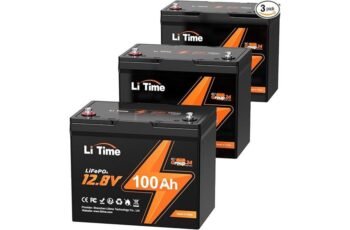
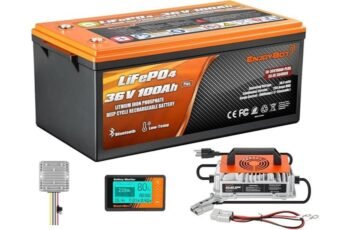
We find that a 12V 100Ah Group 24 LiFePO4 battery provides 1.28kWh of storage, with a 150A BMS for protected operation and substantial loads. Its compact case suits RVs, boats, and off-grid systems, but you’ll need to verify dimensions, terminals, wiring, and charging compatibility. Charging can use solar, a generator, or a 14.6V charger; cold-temperature cutoffs also matter. We’ll explain the specifications, trade-offs, and installation checks to help you judge whether it fits your system.
Key Takeaways
- This Group 24 LiFePO4 battery provides 12V, 100Ah, and 1.28kWh in a compact format; confirm dimensions and terminal fit before buying.
- Its 150A BMS offers cell balancing, app monitoring, and protection against overcharge, over-discharge, overcurrent, and short circuits.
- It suits RVs, boats, and off-grid systems, but is not designed for engine starting or golf carts.
- Charging options include a compatible 14.6V, 20A charger or solar with a 600W-or-higher MPPT; cold-weather charging may be restricted.
- Check your load, wiring, installation space, and expansion needs; up to 16 batteries may be configured in a compatible 4P4S system.
12V 100Ah Group 24 Specs
The 12V 100Ah Group 24 LiFePO4 battery stores 1.28kWh and delivers up to 1.92kW of power. We can connect multiple units to expand storage to 20.48kWh and output to 30.72kW, using a 4P4S arrangement of 16 batteries.
This capacity suits RVs, boats, off-grid systems, and home energy storage. Before installation, we should verify the Group 24 dimensions against the available battery compartment and confirm the terminal configuration matches our cables and equipment.
The stated voltage and capacity define the unit’s nominal energy, while its maximum power indicates the load it can support. We should size wiring and system components accordingly.
Detailed features
To protect the battery under demanding conditions, its upgraded 150A BMS monitors charge, discharge, current, and temperature, while Grade A cells support consistent performance. It guards against overcharging, over-discharging, overcurrent, and short circuits, and balances cells automatically.
Temperature safeguards cut off charging above 167°F and protect against low-temperature charging damage; the operating range is -4°F to 140°F. If discharge current exceeds 220A, the BMS disconnects the battery. We can check real-time status through app monitoring.
For charging, the unit supports solar with a 600W-or-higher MPPT, a generator, or a 14.6V 20A charger; a full charge takes about two hours.
Pros and Cons
We’ll weigh the battery’s expandable capacity, 150A BMS protections, temperature cutoffs, and fast-charging options against its application limits. We’ll also consider its cycle-life claims and app monitoring when evaluating practical value.
It isn’t designed for starter or golf-cart use, so we’ll account for that constraint.
Pros
Although its Group 24 format stays compact, this 12V 100Ah LiFePO4 battery offers 1.28kWh of capacity, a 150A BMS, Grade A cells, and protection against overcharging, over-discharging, overcurrent, short circuits, and temperature extremes.
Its high energy density delivers useful storage without a bulky footprint, while the 150A rating supports substantial loads. We can expand capacity to 20.48kWh and output to 30.72kW in a compatible 4P4S setup.
Temperature cutoffs, auto-cell balancing, and app monitoring add practical control. For us, versatile applications include RVs, boats, off-grid systems, and home storage. Solar, generator, or 14.6V charging options also support flexible recharging.
Cons
Despite its strong capacity and protection features, this battery has limitations to take into account. In Cold Weather, its low-temperature cutoff can prevent charging, so we’ll need to warm the battery or use a suitably controlled installation before recharging.
Its operating range also doesn’t cover more extreme conditions. Limited Compatibility matters, too: we shouldn’t use this battery as a starter or golf cart battery, despite its Group 24 format.
At 100Ah, one unit may not meet higher energy demands, requiring additional batteries and compatible wiring. We’ll also need a suitable 14.6V charger or solar MPPT system to achieve the stated charging performance.
Concluding thoughts
For RV, marine, off-grid, and home-storage use, this 12V 100Ah Group 24 LiFePO4 battery combines a 1.28kWh capacity with a 150A BMS, temperature cutoffs, and app monitoring.
We see its real world value in protected operation, expandable capacity, and charging flexibility, including solar, generator, or a compatible 14.6V charger. Its ideal applications include powering onboard equipment, outdoor tools, and modest backup systems—not engine starting or golf carts.
Before buying, we’d check load requirements, installation space, and temperature conditions. The battery offers useful monitoring and safety controls, but system design still determines performance. Match wiring and charging equipment to manufacturer limits for reliable operation.
Frequently Asked Questions
Can I Connect This Battery to an Existing Lead-Acid Battery Bank?
No—we shouldn’t connect this lithium battery directly to your lead-acid bank; mixing battery chemistries creates incompatible charging and discharge behavior. For parallel bank compatibility, use matching lithium batteries and a lithium-compatible charger and controller.
What Cable Gauge Is Recommended for a 150A Continuous Load?
For a 150A continuous load, we’d start with 1/0 AWG copper for short runs; longer runs may need 2/0 AWG. Use Cable Gauge Selection and Voltage Drop Calculation to verify distance, insulation rating, and acceptable drop.
Does the Battery Require a Special Charger Profile for Lifepo4?
Yes, we recommend a LiFePO4-compatible charger with a 14.6V LiFePO4 charging voltage; the battery supports a 14.6V, 20A charger. Its BMS temperature protection helps prevent charging in unsafe temperature conditions.
Can the Battery Be Installed Inside an RV Without Ventilation?
Yes, we can install it inside an RV without dedicated ventilation, but don’t box it in like a sealed vault. For battery mounting and enclosure placement, follow manufacturer clearances, protect terminals, and avoid heat sources.
How Should I Store the Battery During Extended Periods of Non-Use?
For extended storage, we recommend disconnecting the battery and keeping it cool and dry. Maintain a 50–60% Storage charge level, check it periodically, and use temperature control to stay within manufacturer-specified limits.
Conclusion
The 12V 100Ah Group 24 LiFePO4 battery offers a compact 1.28kWh, 150A-protected power source for RVs, boats, solar setups, and backup systems. Its temperature cutoffs, cell balancing, and app monitoring add useful safeguards and visibility, while 4P4S expansion supports larger installations. Still, we should match its charging limits and operating conditions to our equipment—and remember it isn’t designed for engine starting or golf carts. If those constraints fit, this battery may be a practical building block; the key question is whether its real-world output meets your load.