48V Lithium Golf Cart Battery: Product Overview
Can an $879.99 battery replace a conventional lead-acid setup and still deliver enough range for a full round? The CHINS 48V Lithium Battery Golf Cart 102AH is designed to make that trade-off attractive, combining a 5.22kWh LiFePO4 pack, a 200A battery management system, an included charger, an onboard monitor, and app tracking. For golfers who are tired of watering batteries and carrying a heavy battery bank, this 48V lithium golf cart battery looks like a substantial upgrade, although its advertised range still depends heavily on the cart and route.
At the time of writing in 2026, the listed price is $879.99, reduced from $1,019.99, and the product is shown as in stock. That places it well above a basic replacement lead-acid bank but gives us a complete lithium package rather than a battery-only purchase. The central question is whether the lower maintenance and claimed longevity justify the upfront cost.
CHINS states that the battery can travel up to miles per full charge when powering a 3kW golf cart motor under its test conditions. That figure should not be treated as a guaranteed route distance: hills, payload, speed, temperature, tire pressure, and the condition of the cart all matter. In our assessment, the 48V lithium golf cart battery is worth considering for regular 48V cart owners, but the fit, controller demand, and real-world energy use need checking before purchase.
We examine capacity, output, charging, protection, installation, digital monitoring, customer-review availability, suitable use cases, and long-term value. That gives us a clearer picture than the cycle-count headline alone.

CHINS 48V Lithium Golf Cart Battery Specifications and Fit
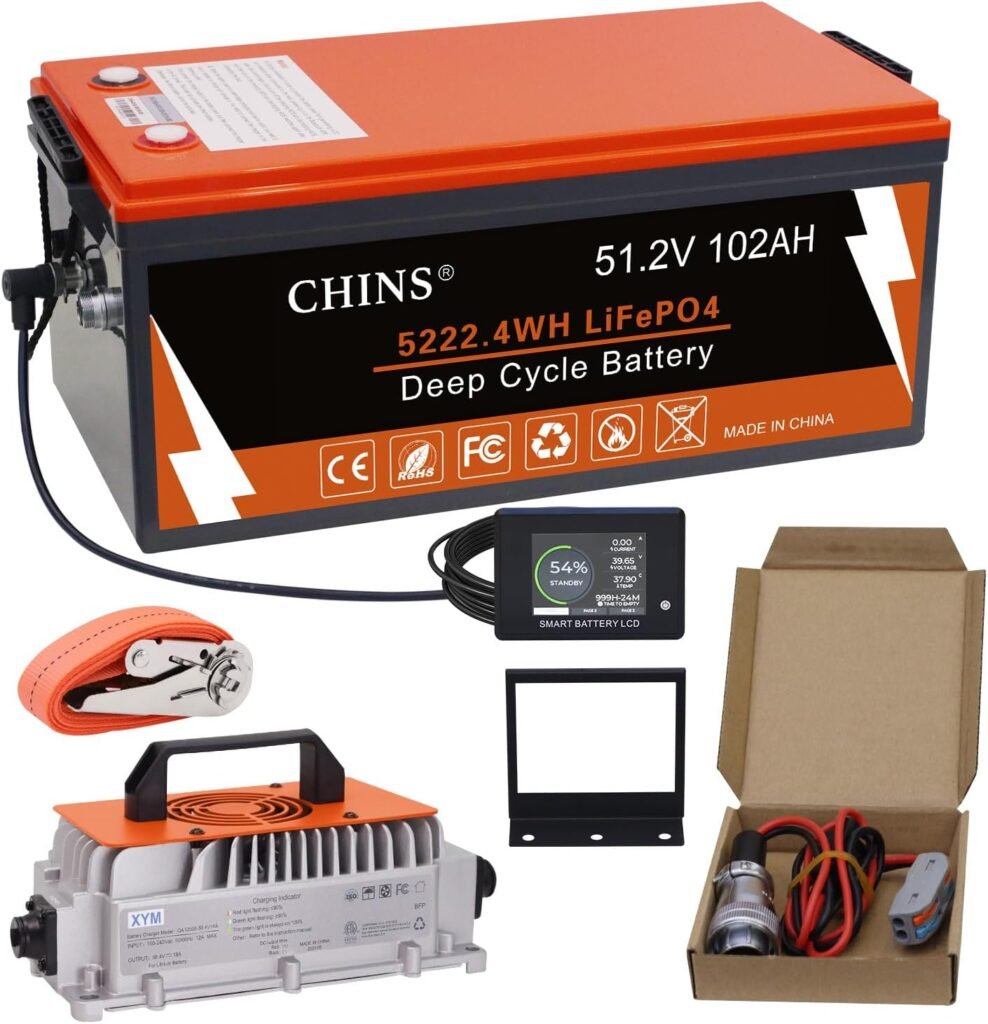
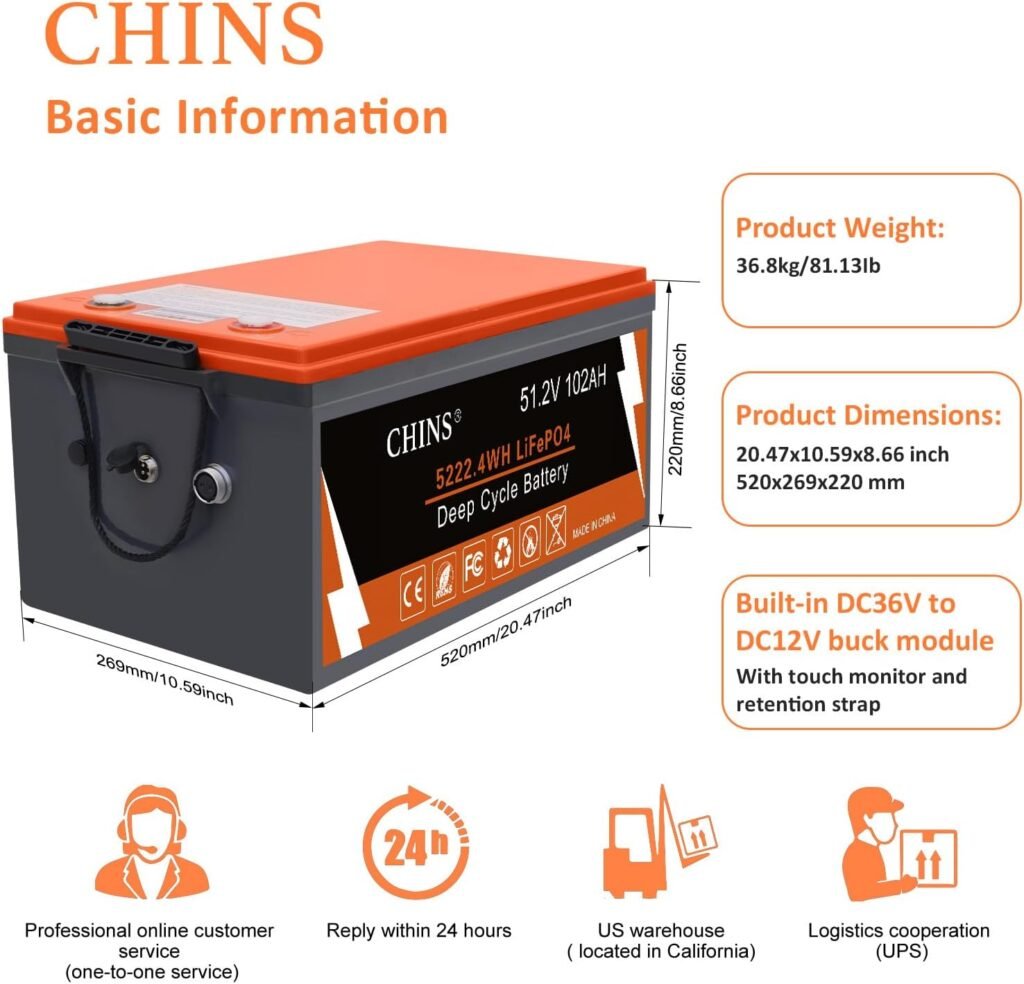
The physical package measures 20.47 x 10.59 x 8.66 inches. That is the first compatibility question for this 48V lithium golf cart battery, not an afterthought. Battery bays differ between Club Car, EZGO, Yamaha, and other carts, so the listed voltage does not prove that the housing, terminals, or mounting points will fit.
We would start by photographing the existing compartment, then measure its usable length, width, and height with cables and covers included. The black-and-orange housing is described as maintenance-free, and CHINS claims a 30% weight reduction compared with lead-acid batteries. In practical terms, owners should no longer need routine watering or cleanup associated with acid spills, but the pack still needs a secure installation that prevents movement and cable strain.
Although golf carts are the main application, CHINS also markets this 48V lithium golf cart battery for trolling motors, RV equipment, marine systems, solar storage, and off-grid use. Those applications can have different current demands and charging arrangements, so “48V” alone is not enough to confirm suitability.
- Confirm the cart’s nominal voltage and motor requirements.
- Check cable routing, terminal orientation, mounting method, and overhead clearance.
- Compare the charging connection with the supplied charger.
- Review controller limits before connecting the pack.
Parallel connection support may permit extra capacity, but we would only do that with matching batteries, suitable fusing, correct wiring, and manufacturer guidance. Combining different ages, chemistries, capacities, or states of charge can create avoidable balancing and safety problems.
200A BMS Output and LiFePO4 Protection Features
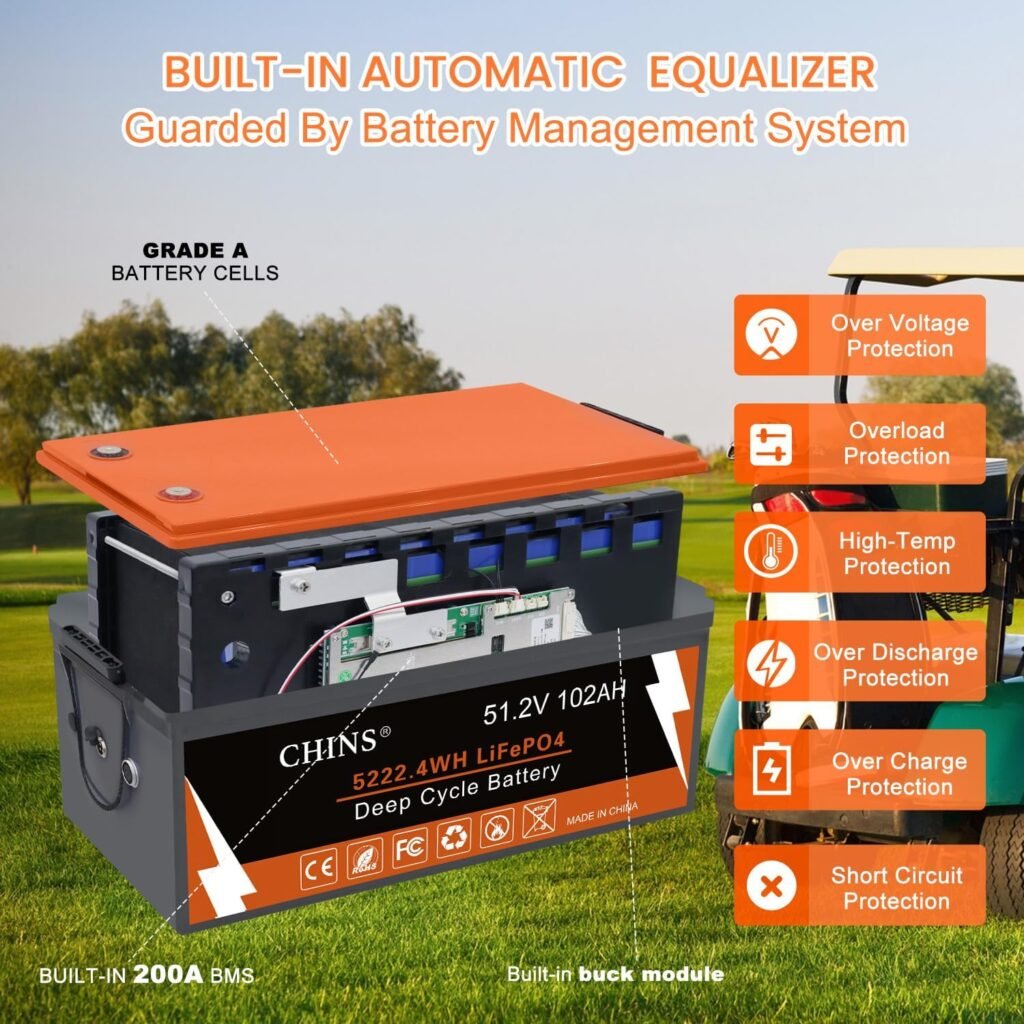
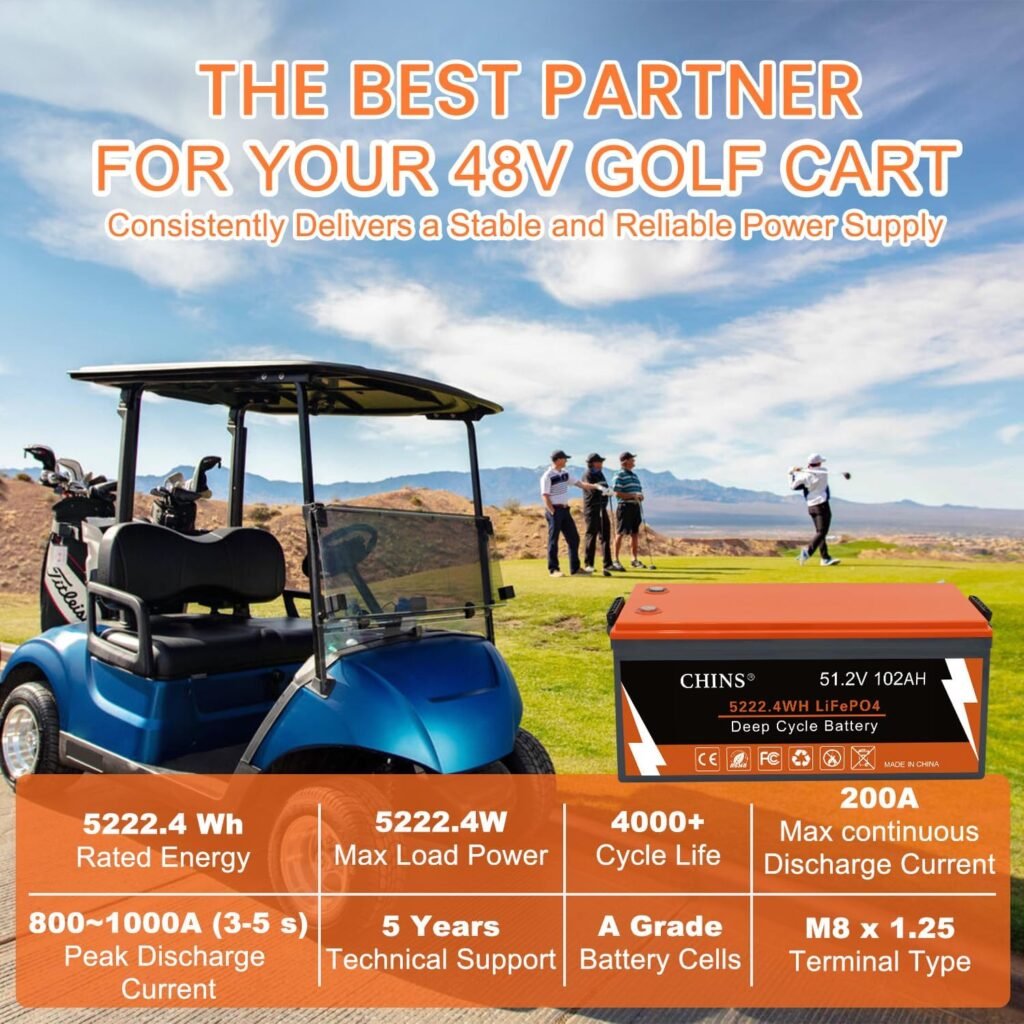
The headline electrical feature is a stated 200A continuous discharge capability. CHINS also lists short-duration output of 1,000A for to seconds, 600A for seconds, and 300A for seconds. Those figures suggest useful surge headroom for acceleration, but peak output is not the same as sustained performance, and the cart’s controller, cables, connections, and motor must still be able to handle the requested current.
The company states that this 48V lithium golf cart battery can support motors up to 8kW and trolling motors rated up to pounds. We would treat those as compatibility claims rather than a promise that every 8kW installation will perform identically. Before fitting it to a high-demand cart, check the controller’s maximum current, cable gauge, fuse or breaker arrangement, and the condition of the motor.
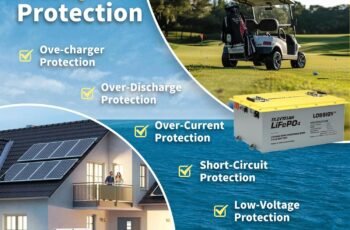
Its built-in BMS is specified to protect against overcharge, over-discharge, over-current, short circuit, and high temperature. CHINS lists a high-temperature cutoff above 122°F. That matters in an enclosed golf-cart bay, a sun-heated boat, an RV compartment, or any poorly ventilated installation where heat can build during charging or heavy use.
A 0V wake-up function is included for low-voltage protection. If the pack enters that state, we would disconnect unnecessary loads, inspect the wiring, use the supplied lithium charger, and follow the startup procedure rather than repeatedly forcing the battery awake. LiFePO4 avoids watering and acid spills, but this 48V lithium golf cart battery still requires correct polarity, secure mounting, suitable charging equipment, and protection from impact or water intrusion.

Range, Capacity, and Everyday Golf Cart Performance
The battery is rated at 102Ah and 5.22kWh, giving a 48V cart a sizable energy reserve for daily driving. In simple terms, the watt-hour figure describes the energy stored, while the amp-hour figure describes capacity at the battery’s nominal voltage. Actual usable energy will be lower or higher in practice depending on discharge limits, temperature, load, and how the cart’s electronics measure state of charge.
CHINS quotes miles from a full charge with a 3kW golf cart motor under its test conditions. That makes an 18-hole outing a realistic target for some carts, particularly on fairly level ground with moderate passenger and cargo weight. It does not mean every cart will complete miles, and the 48V lithium golf cart battery should be judged by the route it needs to cover rather than by the maximum marketing figure.
Range can fall with steep hills, heavy loads, aggressive acceleration, underinflated tires, frequent stop-and-go driving, cold weather, or an aging motor and drivetrain. A cart that is mechanically inefficient may consume much more energy than the test vehicle.
To establish your own result, we would use the same route several times:
- Record the starting charge shown by the monitor.
- Log route distance, passengers, cargo, weather, and terrain.
- Drive normally rather than testing only gentle or aggressive acceleration.
- Record the ending charge and compare several outings.
The claimed lower weight can reduce the load carried by the cart, while lithium chemistry generally provides steadier voltage as charge falls. Those are meaningful ownership benefits, but the supplied information does not establish a particular speed increase.
Charging, Monitor, and App Experience
CHINS includes a 58.4V 18A lithium charger and states that a completely depleted pack can charge from 0% to 100% in seven hours. For many owners, including the correct charger is a major convenience because a lead-acid charger is not automatically appropriate for a LiFePO4 pack. The seven-hour figure is an estimate, not a guaranteed time for every charging session.
Actual charging may vary with charger output, battery temperature, conversion losses, starting state of charge, and the BMS’s protection behavior. We would document the first full charge from a low state, including start and finish times, then check whether the displayed charge level changes consistently over the first several cycles. A sudden jump, stalled reading, or unexpectedly early cutoff deserves investigation before relying on the gauge for a long trip.
The onboard monitor is intended to show battery information while driving, while the app allows users to check charging status remotely from home. That combination could be useful for owners who park the cart away from the house, but digital features are only valuable if the readings are stable and visible. Before depending on this 48V lithium golf cart battery’s app, verify the pairing steps, phone permissions, connection range, supported device, and whether the monitor remains readable in direct sunlight.
The 0V wake-up function may help recover the pack after low-voltage protection, but it should not be viewed as permission to repeatedly over-discharge it. We would investigate why the battery reached protection mode, inspect parasitic loads, and correct the cause rather than treating wake-up as routine maintenance.
What Customers Are Saying About the CHINS Battery
The supplied product information does not include a current Amazon star rating or review count, so we cannot responsibly report a figure such as 4.5 out of or claim that hundreds of buyers have reviewed it. That limitation matters: customer feedback is especially useful for a battery because fit, charger behavior, app reliability, and support can vary beyond the printed specification.
Our review of this 48V lithium golf cart battery should therefore separate confirmed product claims from feedback that still needs verification. When the listing’s newest reviews are available, we would look for detailed reports covering installation time, cart model, charge retention, measured range, charger operation, monitor visibility, and app pairing. A short comment saying “works great” is less useful than a buyer who identifies the cart, motor, terrain, distance traveled, and remaining charge.
Fit reports deserve special attention. We would search specifically for Club Car, EZGO, Yamaha, and other 48V models, because a battery can have the correct nominal voltage yet require different brackets, cables, connectors, or bay modifications. Mixed feedback about delivery condition, missing hardware, unclear wiring instructions, inaccurate state-of-charge readings, charger faults, or slow customer service would also affect our confidence.
Before ordering, check the newest reviews rather than relying only on older comments. Packaging, firmware, charger hardware, support practices, and seller identity can change. CHINS states that its four United States agents are CHINS-US, CHINS LiFePO4 Battery, CHINS-STORE, and CHINS-SHOP; we would confirm the seller matches one of those names. Review credibility improves when the buyer describes months of use, charging habits, motor size, payload, and before-and-after range measurements.
Who Should Buy This 48V Lithium Golf Cart Battery?
The strongest match is a 48V golf-cart owner who wants less routine maintenance, lower battery weight, a roughly full-day range target, and a lithium charger included in the package. For frequent golfers, the appeal is practical: there is no watering schedule, no acid cleanup, and less temptation to postpone basic battery care. The 48V lithium golf cart battery also suits owners who plan to keep the cart for several years and value a complete replacement rather than sourcing a charger separately.
Its broader marketing may interest people who use battery power for trolling motors, RV equipment, marine systems, solar setups, or off-grid projects. We would still match nominal voltage, continuous current, charging profile, terminals, enclosure environment, and load requirements for each application. A golf-cart specification should not automatically be transferred to a boat or solar installation without electrical checks.
High-demand cart owners may appreciate the stated 200A continuous output and claimed support for motors up to 8kW. We would verify the controller’s current draw and the limits of the existing cables, connectors, fuse, and switchgear before making that choice.
This is a weaker fit for:
- Owners of 36V carts.
- Buyers whose battery compartment lacks suitable clearance.
- Anyone expecting completely plug-and-play installation without checking connectors or wiring.
- Users who need clearly documented cold-weather charging support.
Our pre-purchase sequence is straightforward: photograph the battery bay, measure clearance, identify the cart model and voltage, inspect the charger connector, check motor and controller ratings, and confirm the seller identity. That process gives this 48V lithium golf cart battery a fair compatibility check before the box arrives.
Price, Lifespan, and Long-Term Value
At $879.99, reduced from $1,019.99, the CHINS package asks for a meaningful upfront investment. The included 58.4V charger, claimed 30% lower weight, maintenance-free operation, and absence of acid handling improve the comparison with replacing a lead-acid bank. The claimed 5,000-plus deep cycles are potentially the largest value advantage, although cycle life is not a fixed promise.
CHINS says its 48V lithium golf cart battery can last to times longer than lead-acid. We would interpret that as a manufacturer claim dependent on depth of discharge, storage conditions, temperature, charging habits, and workload. A battery repeatedly run flat, stored in unsuitable heat, or installed with excessive current demand may not approach the headline figure.
To estimate ownership value, divide the purchase price by the number of years we realistically expect to use the pack. Then add likely costs for replacement chargers, maintenance supplies, installation hardware, downtime, and any wiring work. Frequent golfers, fleet operators, and owners who keep a cart for many years may find the higher initial cost easier to justify than occasional users who drive only a few short trips.
For charger-only needs, the FORM Volt Onboard Golf Cart Battery Charger and the 48V 15A Lithium Battery Charger are Amazon alternatives worth comparing. They are charger alternatives, not direct replacements for this battery, so they do not provide the pack capacity or integrated battery package.
Our buying framework is simple: choose the CHINS package when the dimensions, connector arrangement, motor demand, app requirements, and expected route distance align with the cart. Otherwise, verified fit and electrical compatibility matter more than a 5,000-cycle headline. The 48V lithium golf cart battery offers convincing long-term potential, but only when the installation and charging routine support it.
Pros and Cons
Pros
- Includes a 58.4V 18A lithium charger rather than requiring a separate charger purchase.
- 200A continuous discharge claim with additional short-duration surge output.
- 5.22kWh capacity and a stated 30-mile range under specified 3kW motor test conditions.
- Maintenance-free LiFePO4 chemistry eliminates routine watering and acid-leak concerns.
- Onboard monitor, app charging status, 0V wake-up function, and stated protection against several electrical faults.
- Claimed 5,000-plus deep cycles and 30% lower weight than lead-acid batteries.
Cons
- Physical dimensions and connector setup may not suit every Club Car, EZGO, Yamaha, or other 48V cart.
- The 30-mile range depends on test conditions and may be substantially lower with hills, heavy loads, cold weather, or an inefficient drivetrain.
- The product information supplied for this review does not include a current Amazon star rating or review count.
- Buyers may need to verify wiring, mounting, controller limits, app compatibility, and charger connections before installation.
- The $879.99 upfront price is considerably higher than a basic lead-acid replacement.
- The 8-to-10-times-longer lifespan statement is a manufacturer claim that depends on usage and charging conditions.
Final Verdict
Key Takeaways
- The $879.99 package includes a 5.22kWh LiFePO4 battery, 58.4V 18A charger, onboard monitor, app tracking, and 200A BMS.
- The 30-mile range claim is based on a 3kW motor test and should be treated as a reference rather than a guaranteed distance.
- Physical fit, connector arrangement, controller demand, and cable capacity must be confirmed before installation.
- The maintenance-free design and claimed 5,000-plus cycle life may justify the higher upfront cost for frequent or long-term users.
- The available product information does not supply a current star rating or review count, so buyers should inspect the newest detailed customer reviews before ordering.
Frequently Asked Questions
How far can the CHINS 48V 102Ah battery travel?
CHINS states a maximum range of miles per full charge when running a 3kW golf-cart motor under its test conditions. Hills, payload, speed, tire pressure, weather, driving style, and drivetrain condition can materially change the real distance.
How long does the included charger take?
The supplied 58.4V 18A lithium charger is rated for a seven-hour charge from 0% to 100%. Actual time can vary according to starting charge, temperature, charging losses, and battery protection behavior.
Will this battery fit any 48V golf cart?
No. Voltage is only one part of compatibility. The battery measures 20.47 x 10.59 x 8.66 inches, and buyers should also check cable routing, terminal position, mounting, charger connection, controller limits, and available clearance.
Does the battery include protection features?
The built-in BMS is specified to protect against overcharge, over-discharge, over-current, short circuit, and high temperature. CHINS also lists a high-temperature cutoff above 122°F and a 0V wake-up function for low-voltage protection.
Can the battery be used for applications besides golf carts?
CHINS markets it for trolling motors, RVs, marine systems, solar storage, and off-grid use. Buyers must independently verify voltage, current, charging, terminals, enclosure conditions, and wiring requirements for those applications.