CHINS 48V Lithium Golf Cart Battery Overview
Can a $899.99 48V lithium golf cart battery replace a conventional lead-acid setup while providing longer range, faster charging, and less routine maintenance? The CHINS 48V Lithium Golf Cart Batteries 105AH, 200A BMS, Includes 18A Charger, Monitor, 5000+ Cycles makes a strong case on paper, but it still requires careful compatibility checks before purchase. We see a substantial capacity, high-current protection, Bluetooth monitoring, and a charger included in the box. The early verdict is encouraging for owners of suitable 48V carts, though the advertised 50-mile range should be treated as a test-condition claim rather than a guaranteed result.
This 48V lithium golf cart battery uses a 48V, 105Ah LiFePO4 configuration with a 200A battery management system, a supplied 58.4V 18A charger, Bluetooth app access, and an external monitoring system. CHINS also claims more than 5,000 deep cycles, which is a considerably higher rating than many conventional lead-acid setups.
At the time of review in 2026, the listed price is $899.99 rather than the stated original price of $1,059.99, representing a $160 reduction, and the product is shown as in stock. That price includes equipment that some competing battery packages leave out.
Our qualification is straightforward: confirm the cart’s voltage, tray clearance, cable arrangement, charging system, and controller before ordering. The supplied information does not include a star rating, review total, review dates, independently verified range test, or warranty length, so we won’t invent those figures or present the 50-mile claim as independently established.

Specifications and Included Equipment
The core specification sheet gives shoppers a useful starting point. This 48V lithium golf cart battery is designed as a single 48V LiFePO4 unit rather than a bank of individual lead-acid batteries, which can simplify the battery compartment when the cart and mounting hardware are compatible.
| Specification | Listed detail |
|---|---|
| Nominal system | 48V |
| Capacity | 105Ah |
| Continuous BMS discharge | 200A |
| Peak BMS discharge | Up to 1,000A |
| Charger | 58.4V, 18A |
| Cycle rating | 5,000-plus deep cycles claimed |
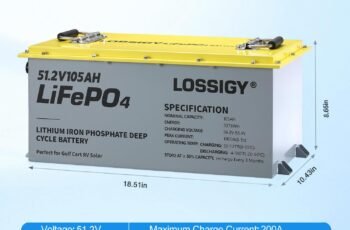
The listed physical dimensions are 19.7 x 11.6 x 8.66 inches. Before ordering, compare those measurements with the tray, lid clearance, hold-down points, terminal position, and cable reach; a battery can be electrically suitable yet physically awkward or unsafe to install.
The package is described as including the battery, an 18A lithium charger, Bluetooth monitoring capability, and an external monitoring system. CHINS advertises a full 0%-to-100% recharge in approximately seven hours. Starting charge level, temperature, charger behavior, and battery protection events can all change the actual time.
Voltage matching is non-negotiable. A 48V lithium golf cart battery isn’t a replacement for a 12V, 24V, or 36V system without a complete, properly designed conversion. The listing supports parallel connections for additional capacity, but it is not intended for series use, so buyers should follow the manufacturer’s wiring instructions rather than improvising an arrangement.
Key Features of the 48V Lithium Golf Cart Battery
The 105Ah capacity represents the battery’s stored electrical capacity, but it doesn’t translate into one fixed mileage figure for every cart. A 3KW motor on flat paths with moderate payload may consume energy very differently from a heavily loaded cart climbing hills at higher speed. Tire pressure, temperature, acceleration habits, terrain, and motor efficiency all influence usable distance.
CHINS advertises up to miles per charge with a 3KW golf-cart motor and says the battery can handle a full holes. Those are manufacturer claims, not a universal performance guarantee. We would treat the range as an upper reference point and leave a sensible reserve rather than planning a long outing around the maximum number.
The 200A continuous BMS rating is intended to support demanding acceleration and high-torque loads, while the listed 1,000A figure applies to short-duration peak demand rather than sustained operation. The cart’s controller, motor, cables, connectors, and fuse protection must also be capable of handling the intended current; a large BMS rating alone cannot upgrade the rest of the drivetrain.
Compared with lead-acid chemistry, LiFePO4 can offer steadier voltage delivery, lower routine maintenance, and less frequent battery-bank handling. CHINS claims more than 5,000 deep cycles and a 30% weight reduction versus lead-acid, but no absolute battery weight is supplied. Built-in protection covers overcharge, over-discharge, short circuit, and high-temperature cutoff.
For a suitable cart, this 48V lithium golf cart battery should feel most attractive to owners tired of watering cells, cleaning multiple terminals, and managing voltage sag. The chemistry’s advantages are real in principle, but actual service life still depends on charging, storage, temperature, and depth of discharge.
Bluetooth App and External Monitoring System
The monitoring package is one of the more practical features of this 48V lithium golf cart battery. The CHINS app and included external monitoring system are intended to show state of charge, battery status, charging progress, and possible fault conditions, giving us more information than a basic cart dashboard gauge may provide.
Before a round, an owner can check whether the battery reached a full charge rather than relying on an old gauge whose calibration may not match lithium voltage behavior. During storage, periodic checks can reveal an unexpectedly low state of charge, while post-charge monitoring can confirm that the charging cycle completed. Visibility won’t increase capacity, guarantee the advertised 50-mile range, or correct undersized wiring.
We recommend a controlled first setup:
- Install the battery and confirm polarity before connecting the cart.
- Use the supplied charger to complete an initial charge.
- Pair the phone with the CHINS app and check the external display.
- Compare both readings and record the battery’s normal voltage or state-of-charge behavior.
Potential limitations deserve investigation before purchase. Phone compatibility, app permissions, Bluetooth reliability, monitoring accuracy, and outdoor readability can affect the experience. The supplied information doesn’t confirm a particular app rating, connection distance, interface layout, or display performance in bright sun.
A 48V lithium golf cart battery with monitoring is easier to understand and troubleshoot than one with no feedback, but the system remains an aid rather than a substitute for correct installation and charging practice.
Charging Performance and 0V Wake-Up Function
The included 58.4V 18A charger is matched to the advertised LiFePO4 system voltage, which matters because lithium batteries require an appropriate charging profile. Using a charger intended for a different chemistry or voltage can cause poor charging, protection cutoffs, or potential safety problems. The supplied charger adds convenience because a separate lithium charger isn’t required at the outset.
CHINS states that a completely depleted battery can recharge from 0% to 100% in approximately seven hours. A partial recharge should normally take less time, although the final charging stage may not proceed at a constant rate. Temperature, starting state, cable condition, and BMS intervention can alter the result, so seven hours is best used as a reference rather than a stopwatch promise.
The 0V wake-up function is intended for a deeply discharged battery that appears inactive to a conventional charger. It may help the charger recognize and begin recovering the battery, but it isn’t permission to repeatedly run the pack completely flat. Frequent deep depletion can reduce practical service life and may activate protective shutdowns.
For routine charging, inspect the cables and connectors, place the cart in a dry and ventilated area, connect the charger as directed, allow the cycle to finish, and disconnect it according to the manual. Avoid charging when wiring is damaged or the battery is unusually hot.
Shoppers comparing alternatives should distinguish format as well as output. The FORM Volt Onboard Golf Cart Battery Charger is aimed at a permanently mounted setup and is listed as a 48V 15AMP charger, while the 48V 15A Lithium Battery Charger is a lower-current charger option. The CHINS package offers an included 18A solution, but compatibility with the cart’s connector and charging arrangement still needs confirmation.
For this 48V lithium golf cart battery, included-charger convenience may outweigh the appeal of an onboard alternative for owners who want a portable-style arrangement. Buyers seeking a fixed onboard installation may reasonably prefer a purpose-built mounted charger instead.

Installation, Fit, and Golf-Cart Compatibility
CHINS presents this 48V lithium golf cart battery as a drop-in replacement, but “drop-in” should not be interpreted as universal plug-and-play compatibility. The sensible process is to remove the existing battery bank, clean and inspect the compartment, place the new unit securely, connect the correct cables, and verify polarity before powering the cart.
Measure the battery tray, lid clearance, cable reach, and mounting points before ordering. The listed footprint is 19.7 x 11.6 x 8.66 inches; those dimensions may fit a standard tray, but cart designs vary. Also inspect the charge port, solenoid, controller, motor rating, existing cables, and battery hold-down system.
Older chargers may use a lead-acid charging profile, and some carts have gauges or controllers calibrated around lead-acid voltage behavior. A conversion may therefore require a compatible charger, connector work, updated cabling, or controller adjustments even when the battery itself fits the compartment.
First confirm that the cart is built for a 48V battery system, then identify its make, model, controller, motor rating, and charging connector. EZGO, Club Car, Yamaha, and other platforms can differ by generation and configuration, so compatibility with one model should never be treated as proof that every 48V cart will accept the unit.
Secure mounting matters because a moving cart creates vibration and sudden movement. The claimed 30% lower weight than lead-acid may make handling easier, but the lighter unit still needs an appropriate restraint system that prevents shifting without damaging the case.
Anyone unfamiliar with high-current DC wiring should use a qualified installer. A 200A continuous rating means an accidental short circuit can be particularly hazardous; insulated tools, correct fusing, sound lugs, and proper cable routing are not optional details.
For a 48V lithium golf cart battery installation, professional help is often cheaper than correcting reversed polarity, loose terminals, damaged connectors, or an incompatible charging circuit after the fact.
What Customers Are Saying About the 48V Lithium Golf Cart Battery
The supplied product information does not provide a current star rating, review count, review dates, or verified buyer comments for this 48V lithium golf cart battery. We therefore cannot honestly say that many buyers praise its range, that several owners report charging problems, or that a particular cart platform has a proven success rate. Those figures and patterns should be checked on the live listing before purchase.
When reviewing the customer record, we would organize comments around installation fit, distance achieved after a full charge, acceleration under load, charging duration, Bluetooth pairing, monitor readability, charger reliability, and customer-service response. A useful review identifies the cart model, motor size, terrain, payload, charging routine, and measured distance rather than simply saying the battery is “good” or “bad.”
Repeated observations deserve more weight than isolated complaints, but even recurring issues need context. A report of short range may reflect hills, soft tires, heavy passengers, high speed, or a controller problem. A charging complaint may involve an incompatible charger, loose terminal, damaged connector, or a battery that entered BMS protection rather than a failed cell.
Our suggested reading method is simple:
- Sort the review page by most recent.
- Read both one-star and three-star comments, not only the highest ratings.
- Check the verified-purchase label where available.
- Look for named EZGO, Club Car, Yamaha, or other cart platforms.
- Compare claimed results with the listing’s 50-mile, approximately seven-hour, and 5,000-plus-cycle figures.
Until a live review record is available, we should regard this 48V lithium golf cart battery as promising on specification but not independently validated through a supplied rating or review sample.
How the CHINS Battery Compares With Alternatives
Against a conventional lead-acid bank, this 48V lithium golf cart battery offers a simpler single-unit format, no routine watering, steadier voltage delivery, and the potential for less terminal cleaning. The advertised 30% lower weight can also make removal and installation easier, while the claimed 5,000-plus cycle rating is a major theoretical advantage over ordinary lead-acid service life.
Those benefits come with a substantial upfront cost: $899.99 currently, compared with the stated original price of $1,059.99. Long-term value depends on how often the cart is used, how well the battery is stored and charged, and whether real operating conditions resemble the conditions behind the rated cycle figure. A cycle claim shouldn’t be treated as a guaranteed lifespan.
Charger choice changes the comparison. The FORM Volt Onboard Golf Cart Battery Charger suits shoppers who want a permanently mounted 48V, 15AMP charger arrangement, while the 48V 15A Lithium Battery Charger may suit someone replacing a separate charger. CHINS includes an 18A charger, making the package convenient, but the charging connector, chemistry profile, and physical installation format must match the cart.
We would compare more than voltage alone: amp-hour capacity, BMS current rating, physical fit, monitoring, charger inclusion, warranty, technical support, and verified customer feedback all affect the purchase. Competing products should not be treated as direct substitutes until their chemistry, capacity, dimensions, and cart compatibility are confirmed.
In practical terms, a 48V lithium golf cart battery is most compelling when we value lower maintenance and repeated use enough to justify the initial outlay. Buyers seeking the cheapest immediate replacement may find a lead-acid bank easier to budget for, even if its ownership demands are higher.
Who Should Buy This 48V Lithium Golf Cart Battery?
The best match is an owner of a compatible 48V golf cart who wants one lithium unit, lower routine maintenance, integrated monitoring, strong high-current capability, and a charger included in the package. Frequent golfers stand to gain more than occasional users because repeated outings make lighter handling, monitoring, and the claimed cycle rating more meaningful.
The listing also names trolling motors, RVs, marine systems, and solar setups as possible applications. Each requires separate checks for voltage, current demand, enclosure conditions, charging equipment, wiring, and protection. A battery’s broad marketing description doesn’t eliminate the need to match the complete electrical system.
We would look elsewhere if the cart uses 36V or 12V, if the lowest possible upfront price is the priority, if the application requires series connections, or if tray fit and charger compatibility cannot be confirmed. Parallel expansion is listed, but series use is specifically not intended.
The 200A continuous BMS rating is attractive for high-torque work, yet the motor, controller, cables, fuse protection, and connectors must support the required current too. Installing a higher-rated battery into an otherwise undersized system won’t automatically improve acceleration and may expose weak components.
Before ordering this 48V lithium golf cart battery, we recommend six checks: confirm system voltage, measure the installation space, inspect the charge port, identify the required charger, check the controller and motor, and review the current customer-feedback record. If any answer is uncertain, pause the purchase and obtain the cart’s wiring information first.
Price, Long-Term Value, and Ownership Costs
At $899.99, the CHINS package is a significant investment rather than a budget replacement. The stated original price is $1,059.99, so the current reduction is $160, and the included charger plus monitoring equipment improve the package’s practical value compared with a battery-only purchase.
Ownership cost should be compared with the full lead-acid experience, not just checkout totals. Lead-acid may involve watering, terminal cleaning, lower charging efficiency, more frequent replacement, installation labor, and downtime when the bank weakens. Lithium can reduce some of those chores, but the initial payment, compatibility work, and any future charger or installation expenses still belong in the calculation.
CHINS rates the battery at more than 5,000 deep cycles. That could be a powerful long-term advantage, but it remains a rated claim whose real outcome depends on operating temperature, discharge depth, storage, charging habits, and maintenance of the surrounding system.
To estimate personal value, multiply expected charge cycles per year by the number of years we plan to keep the cart. Then compare that use pattern with the number of lead-acid replacements, watering sessions, terminal inspections, and downtime periods likely over the same span. A frequent-use owner may justify the premium more readily than someone who drives only a few times each season.
Warranty length is not supplied in the available product data, which is a purchasing gap to verify. We would also check return terms, technical support, charger replacement availability, and app support before paying the current price. In 2026, the $899.99 figure is useful for evaluating today’s value, but we shouldn’t assume the discount or price will remain unchanged.
For this 48V lithium golf cart battery, value is strongest when the cart is compatible and used often enough to benefit from the included equipment and reduced maintenance.
Setup and Care Recommendations
Our first-use routine for this 48V lithium golf cart battery would begin before any electrical connection. Inspect the package for shipping damage, photograph the terminals and accessories, confirm polarity and the installation space, mount the battery securely, connect the system with the correct cables, and complete an initial charge using the supplied charger.
After charging, pair the CHINS app and test the external monitor before taking a long outing. This gives us a baseline for how the state-of-charge reading changes during ordinary driving and helps identify a pairing or display problem while the cart is still at home.
For storage, keep the battery dry, use the correct charger, avoid unnecessary full depletion, and check its condition periodically during extended inactivity in line with the manual. Maintenance-free means we shouldn’t need to add water, but it does not mean inspection-free.
Periodically examine terminals, cable lugs, mounting hardware, connectors, insulation, and the cart’s charging system. Stop using the setup if we see swelling, damaged insulation, unusual heat, a burning odor, repeated BMS cutoffs, or abnormal charger behavior. Disconnecting safely and seeking qualified assistance is preferable to continuing a questionable installation.
Finally, don’t connect the unit in series when the listing specifies parallel expansion only. Any capacity expansion should follow the manufacturer’s wiring instructions and use matched equipment. For owners who follow those precautions, this 48V lithium golf cart battery offers a manageable route away from routine lead-acid maintenance without removing the need for sensible electrical care.
Pros and Cons
Pros
- 105Ah LiFePO4 capacity in a single 48V battery format
- 200A continuous BMS rating with up to 1,000A peak claim
- Includes a 58.4V 18A charger, Bluetooth monitoring, and external monitor
- Advertised 5,000-plus deep cycles and 30% lower weight than lead-acid
- Built-in overcharge, over-discharge, short-circuit, and high-temperature protection
Cons
- $899.99 is a substantial upfront cost for a golf-cart battery
- The advertised 50-mile range has not been independently verified in the supplied information
- Compatibility still depends on tray fit, cart wiring, controller, connector, and charging system
- Warranty length, current rating, review total, and review history were not supplied
- Parallel expansion is supported, but series connections are not intended
Final Verdict
Key Takeaways
- The $899.99 package combines a 48V, 105Ah LiFePO4 battery with a 200A BMS, 18A charger, Bluetooth access, and external monitoring.
- CHINS claims up to miles per charge, approximately seven-hour full charging, more than 5,000 deep cycles, and 30% lower weight than lead-acid; these are advertised figures rather than independently verified results.
- Compatibility requires checking the cart’s 48V system, tray, cables, charger, connector, controller, and mounting arrangement.
- The battery is best suited to frequent-use 48V cart owners who value lower maintenance and monitoring enough to justify the upfront price.
- Warranty details, current customer ratings, review counts, and independently tested range information should be confirmed before ordering.
Frequently Asked Questions
What golf carts is the CHINS battery compatible with?
It is designed for compatible 48V golf carts, but the available information does not confirm universal fit across EZGO, Club Car, Yamaha, or other platforms. Check the cart’s voltage, tray, cable arrangement, charge connector, controller, and motor before ordering.
How far can the CHINS 105Ah battery travel on one charge?
CHINS advertises up to miles per charge with a 3KW golf-cart motor and says it can handle a full holes. Actual range depends on terrain, payload, tire pressure, speed, temperature, motor efficiency, and driving style.
How long does the included charger take to recharge the battery?
The supplied 58.4V 18A charger is advertised to recharge the battery from 0% to 100% in approximately seven hours. A partial recharge should generally take less time, but temperature, starting state, and BMS protection can affect the result.
Can this battery be connected in series?
No. The listing supports parallel connections for expanded capacity and specifies that the battery is not intended for series use. Follow the manufacturer’s wiring instructions for any expansion.
Does the battery include monitoring equipment?
Yes. The package description includes Bluetooth monitoring through the CHINS app and an external monitoring system. Buyers should verify phone compatibility, app permissions, connection reliability, and outdoor display readability.