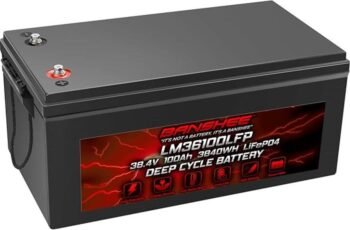
We find the 12.8V 220Ah LiFePO4 battery offers substantial capacity, a 200A continuous discharge limit, and useful Bluetooth and display-based monitoring. Its listed dimensions, 367 × 183 × 241 mm, match the 100Ah model, but we’d still verify clearance, weight, and connections before installation. The 14.6V charge voltage and 9–11-hour charge time require planning. We’d also confirm temperature suitability, load compatibility, Bluetooth reliability, and warranty terms; the details below help clarify whether it fits your setup.
Key Takeaways
- The 220Ah battery provides 12.8V capacity in a listed 367 × 183 × 241 mm footprint, matching the 100Ah model.
- Its 200A continuous discharge rating supports substantial loads, but inverter and appliance demand must stay within that limit.
- Bluetooth monitoring, a charge-level display, an integrated BMS, and Anderson, USB, and Type-C connections add useful features.
- Charging uses 14.6V, takes a listed 9–11 hours, and is specified for temperatures from 0°C to 50°C.
- The battery is rated for 4,000–5,000 cycles; verify fit, compatibility, Bluetooth reliability, and warranty terms before buying.
220Ah Capacity and Dimensions
The 220Ah model pairs a 12.8V rating with dimensions of 367 × 183 × 241 mm, matching the 100Ah version’s footprint. For Capacity comparison, we can note that this model stores 120Ah more without increasing its listed length, width, or height. That makes dimensional fit straightforward when you’re replacing a 100Ah unit in an existing space, provided the installation also accommodates the battery’s weight and connections. The larger 280Ah and 300Ah options measure 442 × 184 × 241 mm, so they require more length. We should verify available clearance before selecting a capacity, rather than assume all four versions share one enclosure size.
Detailed features
Beyond its 367 × 183 × 241 mm footprint, the SSCYHT 220Ah battery includes a Bluetooth board, an integrated intelligent BMS, and a power display for monitoring charge level. We can use Bluetooth monitoring to check battery status, while the display provides a direct local reading. The BMS protection system manages battery operation; the available specifications don’t detail its individual safeguards. Red and black terminals identify positive and negative connections, and the unit also provides an Anderson port, USB, and Type-C interfaces. Its rated voltage is 12.8V, with a 14.6V charge voltage and a maximum continuous discharge current of 200A for this capacity.
Pros and Cons
We’ll assess the battery’s advantages, including its 4,000–5,000-cycle life and integrated BMS, against its limitations. We’ll focus on how its 200A continuous discharge rating, charging time, and operating-temperature range affect practical use. This comparison will help you judge whether it suits your application.
Pros
A key advantage of the SSCYHT 12.8V 220Ah battery is its 200A maximum continuous discharge rating, which supports higher loads than the 100Ah model’s 100A limit. For us, that makes it a stronger fit for demanding RV, golf-cart, and backup-power applications. Its 12.8V LiFePO4 chemistry and 4,000–5,000-cycle rating support long-term use, while the integrated BMS helps manage battery protection. The display provides real-time charge-level monitoring, and Bluetooth adds convenient access to battery information. Anderson, USB, and Type-C interfaces expand connection options. Although its 9–11-hour charge time isn’t exceptionally short, we can plan charging reliably and expect dependable output for everyday use.
Cons
Despite those strengths, the 220Ah model has trade-offs: its 9–11-hour charge time may limit quick turnaround, and its 200A continuous discharge ceiling won’t suit loads that exceed that rating. We should size our inverter and appliances to stay within that continuous limit, rather than assume the large capacity supports higher peak demand. The listed details don’t specify Warranty coverage, so we’ll need to confirm duration, exclusions, and support terms before buying. Bluetooth reliability also remains unverified; we shouldn’t depend on app monitoring without testing the connection. Charging requires temperatures from 0°C to 50°C, which may constrain use in cold environments.
Concluding thoughts
Overall, the SSCYHT 12.8V 220Ah LiFePO4 battery offers a 200A maximum continuous discharge rating, a built-in BMS, Bluetooth monitoring, and a real-time power display in a metal case measuring 367 × 183 × 241 mm. We’d consider its 4,000–5,000-cycle rating promising for Long Term Reliability, though actual service life depends on operating conditions and charging practices. Its 14.6V charge voltage and 9–11-hour charge time help guide system planning. Ideal Applications include solar storage, RVs, golf carts, and backup power, provided the load stays within limits. Before buying, we’d verify compatibility, temperature range, and installation requirements for your setup.
Frequently Asked Questions
Can This Battery Be Connected in Series or Parallel?
We can’t confirm Series connection or parallel connection compatibility from the available specifications. Before connecting batteries, check SSCYHT’s manual or contact the manufacturer; mismatched units or unsupported configurations may damage batteries or create safety hazards.
Is a Compatible Lifepo4 Charger Included?
Forsooth, we can’t confirm an Included charger: the package lists only one battery. For charging compatibility, we recommend a LiFePO4 charger rated for 12.8V batteries, with a 14.6V charging output.
Can It Power a Household Refrigerator During an Outage?
Yes, we can power a household refrigerator during an outage using this battery and a compatible inverter. For Refrigerator runtime, we’ll need the fridge’s energy use; Inverter sizing must accommodate its startup surge.
Is the Battery Suitable for Installation Inside an RV?
Yes, we can install this battery inside an RV, provided you verify fit, observe RV installation clearances, and use secure mounting. Keep charging within 0–50°C, protect terminals, and follow the manufacturer’s installation guidance.
Does the Bluetooth App Require a Subscription?
We can’t confirm whether the Bluetooth app requires a subscription; the product details don’t specify App subscription or Bluetooth costs. In particular, this battery supports 4,000–5,000 cycles, but verify app fees with SSCYHT before purchase.
Conclusion
We see the SSCYHT 12.8V 220Ah LiFePO4 as a capable storage option, with a 200A continuous discharge rating, integrated BMS, Bluetooth monitoring, and practical ports. Its metal case and handle suit mobile setups, but we’d verify dimensions, weight, charging voltage, temperature limits, and charge time against our needs. The stated 4,000–5,000-cycle life is promising, not a guarantee. Like a trusty telegraph, its display helps deliver status at a glance—yet installation still demands careful planning.