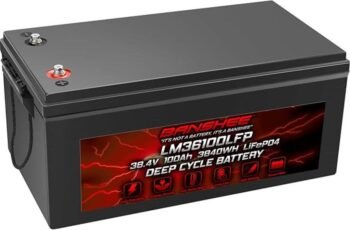
We find this 24V, 300Ah LiFePO₄ battery suits high-demand RV, marine, and off-grid systems needing cold-weather charging protection. Its 7,680Wh capacity, 200A BMS, and 5,120W maximum load support substantial power needs. When charging current exceeds 10A below 0°C, self-heating warms the cells and stops at 5°C; standard charging then resumes automatically. Solar, generator, and 29.2V charging are supported. At 110.2 pounds, installation takes planning. We’ll also consider compatibility, monitoring, and practical trade-offs.
Key Takeaways
- The LM24300 provides 24V, 300Ah capacity, storing 7,680Wh for extended RV, marine, off-grid, or backup use.
- Its 200A BMS supports loads up to 5,120W and monitors electrical and thermal conditions.
- Self-heating starts below 0°C when charging current exceeds 10A, then stops at 5°C so standard charging can resume.
- Charging options include solar, generators, or a compatible 29.2V LiFePO₄ charger; 1,000W solar input takes about eight hours with an MPPT controller.
- At 110.2 pounds and 25 × 9.61 × 8.6 inches, it requires careful installation planning and is not designed for starter or golf-cart use.
Heating Cutoff at 5°C
Once the battery warms to 5°C (41°F), its self-heating system shuts off and standard charging resumes. This temperature threshold ends the Heating cycle, redirecting incoming current from warming the cells to charging them.
We can consequently expect charging behavior to change automatically as the battery reaches the cutoff point; no manual shutdown is specified. The system starts heating only when a charger is connected, charging current exceeds 10A, and battery temperature is below 0°C (32°F).
Between activation and cutoff, heating draws power from that current. This sequence prioritizes cold-temperature protection, then restores standard charging once the cells reach the specified threshold.
Detailed features
Beyond its self-heating system, the LM24300 combines a 24V, 300Ah LiFePO₄ pack with 7,680Wh of energy, a 200A BMS, and app-based monitoring. Its maximum load power reaches 5,120W, while the 25 × 9.61 × 8.6-inch case weighs 110.2 pounds.
We can track voltage, current, power, state of charge, and cycle count through app monitoring. The battery accepts solar, generator, or 29.2V LiFePO₄ charging. With an MPPT controller and at least 1,000W of solar input, charging takes about eight hours.
We can also expand capacity to 61.44kWh in a 2S4P configuration for larger systems.
Pros and Cons
We’ll weigh the battery’s 7,680Wh capacity, self-heating, and 200A BMS against its 110.2 lb weight and charging requirements.
We’ll also assess its app monitoring, system expandability, and application limits. This comparison will help you judge whether its advantages fit your setup.
Pros
The LM24300’s main advantages are its 7,680Wh capacity, integrated cold-weather self-heating, and 200A BMS. Its High Energy Capacity can support loads up to 5,120W, giving us substantial stored energy for extended use.
When connected to a charger supplying more than 10A below 0°C, the heating system warms the cells to 5°C before normal charging resumes. The BMS monitors key electrical and thermal risks, while the app reports voltage, current, power, state of charge, and cycle count.
Versatile Applications include marine systems, RVs, off-grid solar, and backup power. We can also expand capacity through a supported series-parallel configuration.
Cons
Despite its high capacity, the LM24300 weighs 110.2 lb and measures 25 × 9.61 × 8.6 inches, which can complicate installation and handling. We should also consider its application limits and purchase price.
| Drawback | Practical impact |
|---|---|
| Heavy, bulky design | Requires careful lifting and mounting |
| Limited compatibility | Not suitable for starter or golf cart use |
| High upfront cost | Requires substantial initial investment |
For compatible systems, its 24V output and 29.2V charging requirement may mean replacing or adding equipment. We should verify inverter, charger, and installation space before buying. Although the battery supports expansion, planning a larger configuration can add wiring and system costs. These constraints matter most where weight, budget, or existing equipment limits installation options.
Concluding thoughts
For applications that need substantial energy storage and cold-weather charging, the LM24300 combines 7,680Wh of capacity with self-heating and a 200A BMS. Its heater uses charging current below 0°C and stops at 5°C, helping protect cells while restoring normal charging.
We’d consider its 5,120W maximum load, app monitoring, and solar, generator, or 29.2V charging options when planning a system. Ideal applications include marine use, RVs, off-grid solar, and backup power; it isn’t a starter or golf-cart battery.
For long term value, weigh its capacity and expandability against its 110.2-pound weight, dimensions, installation needs, and expected operating demands.
Frequently Asked Questions
What Devices Can the LM24300 Battery Power?
We can power trolling motors, marine equipment, RV appliances, camper vans, home energy systems, solar setups, backup loads, and off grid electronics, provided their combined demand stays within the LM24300’s 5,120W maximum output.
Can This Battery Be Used as a Starter Battery?
No—don’t use the LM24300 as a starter battery; it isn’t designed to crank engines. Think of it as a steady power reservoir, not a burst engine. Starter battery suitability is poor; Cranking power limits matter.
How Many 24V 100AH Batteries Does Its Capacity Equal?
It equals three 24V, 100Ah batteries. For a precise capacity comparison, we see 7,680Wh total energy, matching three units rated at 2,560Wh each; this energy equivalence assumes identical voltage and capacity ratings.
What Charging Methods Are Compatible With This Battery?
We can charge this battery using solar with an MPPT controller, a generator, or a 29.2V LiFePO₄ charger. Compatible Chargers must support its chemistry; observe Charging Temperatures, since self-heating activates below 0°C.
How Many Batteries Can Be Connected in an Expanded System?
We can connect up to eight batteries: two in series and four parallel (2S4P), creating a 51.2V, 1,200Ah system. This confirms the stated Maximum Series Connections and Parallel Expansion Limits, totaling 61.44kWh.
Conclusion
The LM24300’s 5°C heating cutoff helps protect cold-weather charging, while its 7,680Wh capacity and 200A BMS suit demanding RV, solar, and backup systems. App monitoring and support for compatible charging sources add practical value, but installation still depends on system compatibility and clear application limits. Is this the right battery for every 24V setup? No: we wouldn’t use it for engine starting or golf carts. For suitable loads, it offers substantial capacity and useful cold-weather protection.