Understanding the wiring diagram of a lithium battery BMS is critical for ensuring proper system function and safety. Precise connections between the BMS, cells, sensors, and external components directly impact battery performance and longevity. Proper wiring not only prevents faults but also optimizes cell balancing and voltage management. To achieve reliable operation, it’s essential to follow detailed diagrams and best practices. The next steps in wiring can be complex, but they’re essential for long-term system stability.
Key Takeaways
- Ensure correct identification and connection of main BMS terminals to battery pack positive and negative terminals.
- Follow wiring diagrams carefully to connect balance wires across individual cells for proper voltage balancing.
- Incorporate voltage, temperature, and current sensors as specified to monitor system health accurately.
- Verify polarity and secure connections to prevent short circuits and ensure system safety.
- Regularly inspect and test wiring against the diagram to maintain system integrity and performance.
Getting Started With Lithium Battery BMS Wiring
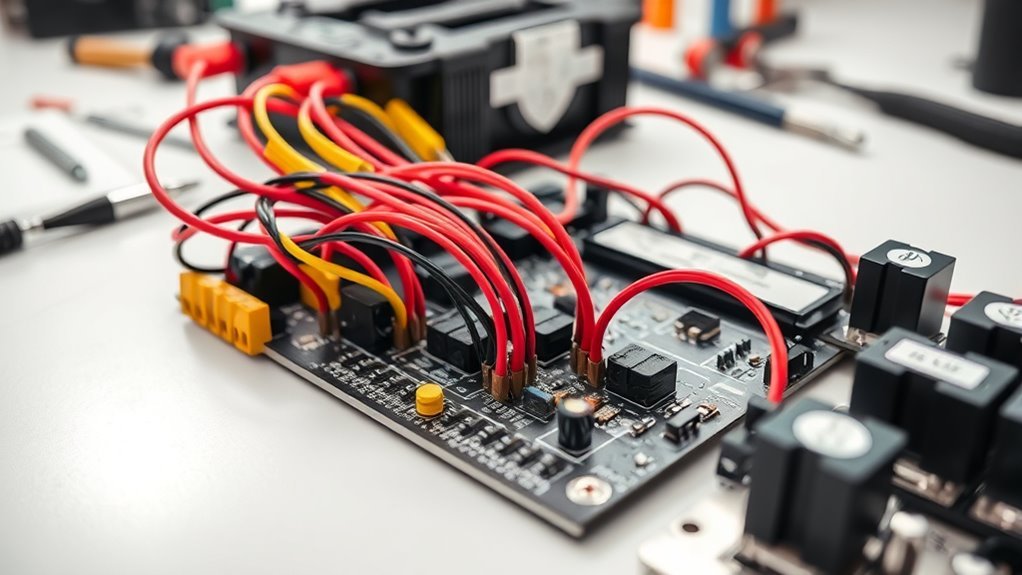
To begin wiring a lithium battery BMS, we must first understand the BMS’s essential connections and their functions. The BMS monitors cell voltages, balances cells, and manages current flow, all vital for safety and longevity. Knowledge of battery chemistry informs the BMS’s voltage and temperature thresholds, guaranteeing proper protection. Correct wiring aligned with specific charging protocols guarantees safe and efficient charging/discharging cycles. For example, lithium-ion batteries require precise voltage limits and current regulation during charging. Properly connecting the BMS to the battery pack involves understanding the role of each terminal—such as cell connectors and power lines—and adhering to manufacturer specifications. This foundational understanding ensures reliable operation, prevents faults, and optimizes battery performance throughout its lifespan.
Identify and Connect the Main BMS Terminals
We need to accurately identify the main terminal functions to guarantee correct wiring and system safety. Proper connection procedures are critical to prevent damage and ensure ideal battery management. Let’s review the key terminals and the correct steps for connecting them precisely.
Main Terminal Functions
Understanding the main terminal functions of a BMS is essential for proper wiring and system operation. These terminals connect to the battery pack, balancing circuits, and external systems, ensuring accurate monitoring of voltage, current, and temperature. The main terminals typically include the pack positive and negative, which are crucial for managing battery chemistry-specific charging protocols. Proper connection guarantees safe and efficient charging, preventing overvoltage or undervoltage conditions. Additionally, the BMS’s main terminals interface with the charger and load, enabling the BMS to control charge/discharge cycles based on battery chemistry parameters. Precise identification and connection of these terminals are indispensable for maintaining system integrity, optimizing performance, and protecting the battery throughout its lifecycle.
Proper Connection Procedures
Proper connection of the main BMS terminals is essential for ensuring accurate monitoring and safe operation of the battery system. Correctly identifying the positive, negative, and communication terminals is critical for effective battery management and voltage regulation. We start by verifying the polarity of each terminal, ensuring the main positive and negative connections align with the battery pack’s configuration. Next, connect the main terminals securely, avoiding loose contacts that could disrupt voltage regulation or lead to system faults. Proper insulation and soldering are necessary to prevent short circuits. Accurate terminal identification and connections enable the BMS to monitor cell voltages precisely, balance cells effectively, and maintain overall system safety. Following these procedures minimizes risks and optimizes battery performance.
Wire Cells and Balance Voltage Properly
Proper wiring of cells is critical to maintain balanced voltage across the entire pack. We must guarantee accurate connection techniques to prevent voltage discrepancies and potential cell damage. Monitoring each cell’s voltage levels allows us to verify balance and optimize battery performance.
Proper Cell Wiring Techniques
To guarantee the safety and efficiency of your lithium battery pack, we must wire the cells correctly and balance the voltage across each one. Proper cell wiring involves understanding battery chemistry to prevent cell damage and ensure longevity. Use appropriate connector types, such as spot-welded tabs or high-quality bus bars, to establish secure, low-resistance connections. Always connect cells in series or parallel according to the desired voltage and capacity, maintaining consistent orientation and polarity. Avoid mixing different battery chemistries, as this can lead to uneven charge and potential failure. Proper wiring minimizes voltage imbalances and reduces the risk of thermal runaway. Precision in wiring techniques ensures each cell contributes uniformly to the pack’s overall performance and safety, which is crucial for peak BMS operation.
Ensuring Accurate Balance Voltage
Ensuring accurate balance voltage requires precise wiring of cells to enable the BMS to monitor and correct voltage discrepancies effectively. Proper circuit connections are essential for reliable battery management, preventing overcharge or deep discharge in individual cells. When wiring cells, ensure each balance wire connects directly across the cell terminals, avoiding loose or incorrect connections. This guarantees the BMS can accurately measure each cell’s voltage and perform balancing tasks efficiently. To clarify, here’s a typical wiring overview:
| Cell Position | Wiring Connection | Voltage Monitoring |
|---|---|---|
| Cell 1 | Positive to BMS + | Yes |
| Cell 2 | Negative to Cell 1 | Yes |
| Cell 3 | Negative to Cell 2 | Yes |
| Cell 4 | Negative to Cell 3 | Yes |
Consistent wiring ensures balanced voltage levels, critical for battery longevity.
Monitoring Cell Voltage Levels
Monitoring cell voltage levels accurately involves connecting each cell to the BMS with dedicated wiring that guarantees reliable voltage measurement and effective balancing. Proper wiring ensures precise voltage regulation across individual cells, which is critical for maintaining overall battery health. By monitoring voltage levels precisely, we can detect voltage imbalances early and implement cell balancing strategies effectively. This process helps prevent overcharge or over-discharge conditions that could damage the battery. Reliable wiring also minimizes measurement errors, guaranteeing the BMS responds correctly to voltage fluctuations. Properly wired cells enable the BMS to perform accurate cell balancing, equalizing voltage levels among cells and prolonging pack lifespan. Ultimately, meticulous wiring for voltage monitoring is essential for safe, efficient, and long-lasting lithium battery operation.
Add Sensors and Monitoring Components
Adding sensors and monitoring components to a lithium battery BMS enhances its ability to accurately track critical parameters and guarantee safe operation. Proper sensor calibration ensures measurement accuracy, minimizing errors during data collection. Integrating temperature, current, and voltage sensors allows real-time environmental and operational monitoring. Data logging capabilities enable exhaustive analysis, aiding in predictive maintenance and performance optimization. Below is a summary of essential components:
| Sensor Type | Function | Key Considerations |
|---|---|---|
| Voltage Sensors | Measure cell voltage | Calibration for precision |
| Temperature Sensors | Monitor cell and ambient temps | Placement for accurate readings |
| Current Sensors | Track charge/discharge flows | Low resistance, high accuracy |
| Data Logger | Record sensor data over time | Storage capacity, integration ease |
Common Wiring Configurations for Lithium BMS
When designing a lithium battery BMS, selecting an appropriate wiring configuration is crucial for accurate cell monitoring and balanced operation. Different configurations depend on battery chemistry, such as LiFePO4 or NMC, which influence wiring complexity and current flow. Common wiring setups include series, parallel, and series-parallel arrangements, each suited for specific voltage and capacity requirements. Connector types, such as JST, Anderson Powerpole, or Molex, are chosen based on current ratings, robustness, and ease of installation. Proper wiring ensures reliable communication between the BMS and individual cells, minimizing voltage imbalances and preventing thermal issues. Precise wiring schemes enhance system safety and performance, making it necessary to match the configuration to both the battery chemistry and connector specifications for efficient operation.
Troubleshooting Wiring Issues and Ensuring Safety
Proper wiring is fundamental to the safety and performance of a lithium battery BMS, but issues can arise that threaten system integrity. Troubleshooting wiring problems involves verifying all connections against the wiring diagram, ensuring correct polarity, and checking for loose or damaged wires. Faulty wiring compromises battery safety, potentially leading to thermal runaway or cell damage. When wiring customization is necessary, it’s vital to follow precise specifications to prevent miswiring. Use a multimeter to confirm continuity and proper voltage levels throughout the system. Regular inspection and adherence to manufacturer guidelines minimize risks. Effective troubleshooting guarantees the BMS functions correctly, maintaining battery safety and prolonging system lifespan. Clear, accurate wiring practices are indispensable for reliable operation and safety assurance.
Frequently Asked Questions
How Do I Choose the Right BMS for My Battery Pack?
We choose the right BMS by matching its current rating to our battery’s capacity and ensuring wiring safety features are compatible. We also verify voltage limits and cell balancing functions to maintain ideal performance and safety for our battery pack.
What Are the Signs of a Faulty BMS Wiring Connection?
When wiring issues crop up, it’s a red flag for faulty BMS connections, risking battery safety. We look for inconsistent voltage readings, overheating, or disconnections, which signal wiring troubleshooting is needed to prevent potential damage or hazards.
Can I Upgrade My BMS Wiring Without Replacing the Entire System?
Yes, you can upgrade your BMS wiring by carefully troubleshooting existing connections and replacing faulty wires, ensuring battery safety. We recommend precise, technical work to maintain system integrity and avoid potential hazards during wiring modifications.
How Does Temperature Affect BMS Wiring and Performance?
Coincidentally, temperature greatly impacts BMS wiring and performance; proper battery cooling reduces overheating, while high temperatures compromise wiring insulation, leading to potential failures. Maintaining ideal temperatures ensures reliable operation and prolongs overall battery system lifespan.
Is It Necessary to Insulate All Wiring Connections in the BMS?
We believe wiring safety and insulation importance are critical; insulating all BMS connections prevents short circuits and enhances reliability, especially under varying temperatures. Proper insulation minimizes risks, guarantees consistent performance, and maintains overall system safety.
Conclusion
Properly wiring our lithium battery BMS is critical for system safety and longevity. By following the correct connections and monitoring protocols, we guarantee peak performance and prevent faults. As the saying goes, “A chain is only as strong as its weakest link,” and meticulous wiring safeguards every component. With attention to detail and adherence to the diagram, we can maximize battery lifespan and reliability, confidently powering our projects with stability and precision.