Did you know that LiFePO4 batteries can last up to 10 times longer than traditional lead-acid types with proper selection? As we consider integrating these batteries into various applications, choosing the right one requires careful evaluation of capacity, voltage, safety features, and brand reliability. Making an informed decision can greatly impact both performance and longevity, but understanding these factors is vital to avoid costly mistakes later. Let’s explore how to choose the most suitable LiFePO4 battery for your needs.
Key Takeaways
- Determine your energy needs to select appropriate capacity and voltage configurations for your application.
- Consider battery chemistry, cycle life, and DoD to ensure longevity and optimal performance.
- Check safety features like BMS, thermal management, and overcharge protection for reliable operation.
- Evaluate cost, maintenance requirements, and environmental impact for long-term value.
- Ensure compatibility with your device’s voltage, charging protocols, and installation constraints.
How to Determine the Right Capacity for Your LiFePO4 Battery
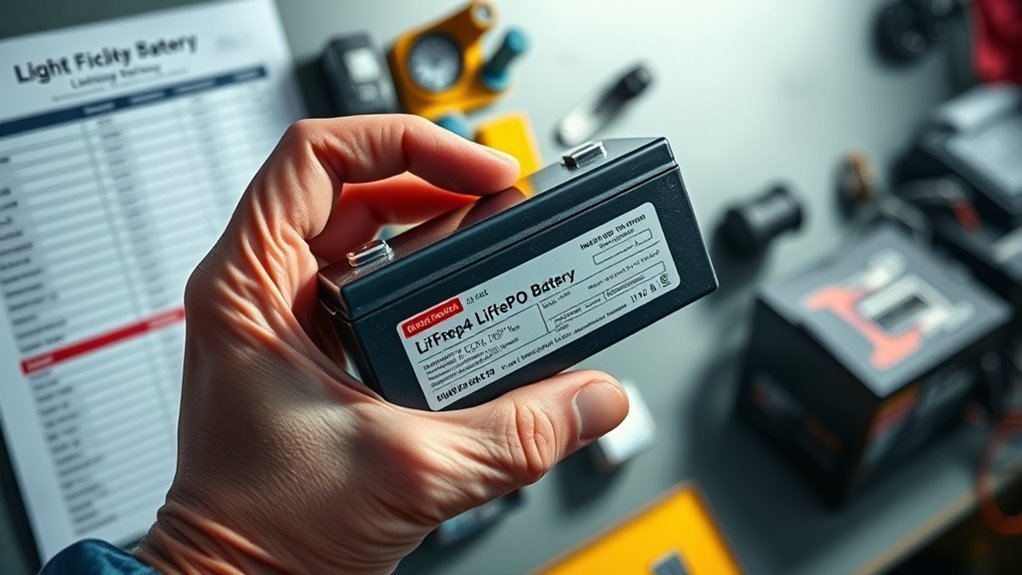
Determining the appropriate capacity for your LiFePO4 battery is a critical step to guarantee reliable performance and longevity. Battery chemistry influences how much energy storage is feasible within a given size and weight, guiding capacity selection. We need to evaluate your energy requirements carefully, considering load demands and usage duration. Charging compatibility also plays a essential role; confirm your charger matches the battery’s specifications to prevent overcharging or undercharging that could compromise capacity and lifespan. Accurate capacity selection minimizes inefficiencies and maximizes cycle life. By understanding your system’s power needs and aligning them with the battery’s chemistry and charging parameters, you can select a capacity that ensures ideal performance, durability, and safety over the battery’s service life.
What Voltage Levels Do You Need in a LiFePO4 Battery?
Understanding the voltage requirements of your application is essential when selecting a LiFePO4 battery, as voltage directly impacts compatibility and performance. LiFePO4 battery chemistry typically provides a nominal voltage of 3.2 to 3.3 volts per cell. For practical purposes, configurations commonly include 12.8V (4 cells in series) and 25.6V (8 cells). Confirming the correct voltage level aligns with your device’s specifications and affects charging protocols, which are optimized for this chemistry. Proper voltage selection guarantees safe and efficient operation, preventing under- or over-voltage conditions. Additionally, matching your battery’s voltage to your system’s requirements ensures consistent power delivery and minimizes risks associated with inappropriate voltage levels, ultimately maximizing battery lifespan and system reliability.
How Do Cycle Life and Depth of Discharge Affect Battery Longevity?
Deep discharges accelerate capacity loss, reducing overall cycle life, while exceeding the recommended cycle count limits can cause premature battery failure. We must consider how frequent cycling and discharge depth influence the battery’s long-term performance. Understanding these factors helps optimize lifespan and reliable operation.
Impact of Deep Discharges
When a LiFePO4 battery undergoes deep discharges, its cycle life can markedly decrease, as each cycle imposes stress on the internal chemistry. Extensive discharges accelerate electrode degradation, reducing overall lifespan. This impacts not only performance but also the sustainability of battery use, influencing battery recycling efforts and environmental impact.
- Deep discharges cause structural strain, leading to capacity fade over time
- Frequent deep cycles shorten the number of usable charge cycles
- Reduced cycle life increases waste, affecting recycling processes
- Lower longevity elevates environmental footprint, emphasizing the need for idealdischarge levels
Understanding these effects helps in designing batteries that balance depth of discharge with longevity, ultimately supporting more sustainable energy solutions and minimizing environmental impact.
Cycle Count Limitations
How do cycle count and depth of discharge (DoD) directly influence the lifespan of a LiFePO4 battery? Battery chemistry determines the inherent durability, with LiFePO4 offering high cycle stability due to its stable chemistry. The cycle count limit refers to the number of full charge-discharge cycles a battery can sustain before capacity diminishes considerably. Higher DoD accelerates capacity fade because deeper discharges stress the battery’s internal structure. Proper charging protocols, including avoiding overcharging and excessive discharge, help optimize cycle life. Maintaining moderate DoD extends cycle count, preserving battery longevity. Consequently, understanding these limitations allows us to implement appropriate charging routines, ensuring the battery operates within its designed cycle parameters and maximizing its effective lifespan.
What Safety Features Should You Look for in a LiFePO4 Battery?
Ensuring safety in a LiFePO4 battery is essential, as it directly impacts reliability and user protection. Key safety features focus on Battery safety and Fire prevention. Look for integrated protections such as:
- Overcharge and over-discharge safeguards to prevent voltage extremes that compromise cell integrity.
- Built-in thermal management systems that mitigate overheating risks during high current loads.
- Battery management systems (BMS) with comprehensive monitoring to detect faults, imbalance, or short circuits.
- Fail-safe venting mechanisms that release pressure safely if internal failures occur.
These features minimize the risk of thermal runaway, explosions, or fires. Prioritizing these safety elements ensures the longevity of the battery and safety during operation.
How to Compare LiFePO4 Battery Quality and Brand Reputation
Evaluating the quality of a LiFePO4 battery and the reputation of its brand requires careful analysis of several key factors. First, examine the manufacturer’s adherence to quality control standards and certifications, which guarantee consistent performance. Consider the battery’s cycle life and capacity retention over time, as these indicators reflect manufacturing quality. Additionally, assess the company’s commitment to sustainability, including practices related to battery recycling and minimizing environmental impact. Brands prioritizing eco-friendly disposal and recycling processes demonstrate responsibility and long-term viability. A reputable manufacturer will transparently provide detailed specifications, warranty coverage, and independent testing results. Overall, thorough evaluation of these aspects helps ensure you select a high-quality, environmentally conscious LiFePO4 battery with a reliable brand reputation.
Which Battery Configurations Suit Different Use Cases?
Selecting the right battery configuration depends heavily on the specific application and energy requirements. Different use cases necessitate tailored arrangements to maximize performance and longevity. For example, series configurations increase voltage for high-power tools, while parallel setups enhance capacity for prolonged use. When choosing configurations, consider battery installation constraints, guaranteeing compatibility with available space and connection requirements. Proper charging protocols are essential; series configurations require balanced charging to prevent overvoltage, whereas parallel setups demand current management to avoid uneven discharge. Additionally, hybrid configurations may suit complex systems with varying load demands. Ultimately, matching the configuration to your use case ensures efficient operation, safe installation, and superior lifespan of the LiFePO4 battery system.
How to Calculate the Total Cost and Long-Term Value of Your Battery
To accurately assess a Lifepo4 battery’s value, we must compare initial costs with its lifespan and maintenance needs. Evaluating energy savings over time helps determine if the investment yields long-term financial benefits. This approach guarantees a thorough understanding of both upfront expenses and ongoing operational efficiencies.
Initial Investment Versus Longevity
While the initial purchase price of a LiFePO4 battery is an important consideration, understanding its long-term value requires analyzing the total cost of ownership over its lifespan. Battery chemistry impacts longevity, as LiFePO4 cells typically endure more charge cycles than other chemistries, reducing replacement frequency. Charging protocols influence cycle life and overall durability, making proper management essential for maximizing lifespan.
- Higher upfront costs often correlate with longer cycle life and reduced replacement frequency
- Proper charging protocols extend battery life, enhancing long-term value
- Battery chemistry determines the number of charge cycles before capacity diminishes
- Total ownership costs benefit from considering both initial investment and operational efficiencies
Cost of Maintenance and Replacements
Understanding the total cost of ownership for a LiFePO4 battery requires careful calculation of maintenance and replacement expenses over its lifespan. Proper adherence to charging protocols preserves battery chemistry and prolongs lifespan, reducing long-term costs. Maintenance involves monitoring voltage levels and thermal management to prevent capacity loss. Replacement costs are influenced by cycle life, typically 2000-5000 cycles, and are minimized with correct charging practices. The following table summarizes key factors:
| Factor | Impact | Cost Implication |
|---|---|---|
| Battery Chemistry | Determines degradation rate | Lower costs with stable chemistry |
| Charging Protocols | Maintain optimal performance | Reduce premature replacements |
| Maintenance Frequency | Affects lifespan and reliability | Increased costs with neglect |
Energy Savings Over Time
Calculating the long-term value of your LiFePO4 battery hinges on accurately evaluating energy savings over its lifespan. This involves appraising efficiency, cycle durability, and overall operational costs. Key considerations include:
- Higher cycle life reduces replacement frequency, lowering total costs.
- Energy efficiency minimizes power loss, maximizing usage per charge.
- Battery recycling potential decreases environmental impact and disposal expenses.
- Long-lasting batteries diminish the environmental footprint compared to less durable alternatives.
Frequently Asked Questions
How Do Temperature Variations Impact Lifepo4 Battery Performance and Lifespan?
Temperature effects considerably influence Lifepo4 battery performance and lifespan; extreme heat accelerates battery degradation, while cold reduces capacity temporarily. Maintaining ideal temperature ranges minimizes degradation, ensuring longevity and consistent performance in diverse environmental conditions.
Can Lifepo4 Batteries Be Safely Recycled or Disposed Of?
Just like recycling cans prevents pollution, Lifepo4 batteries can be safely recycled through proper battery recycling programs, ensuring environmental safety and disposal safety. We recommend following local regulations and certified facilities for responsible disposal and reuse of lithium iron phosphate batteries.
What Are Common Signs Indicating a Lifepo4 Battery Needs Replacement?
We notice a Lifepo4 battery needs replacing when its capacity drops considerably below its original, and it endures fewer charging cycles, indicating diminished performance and potential safety risks. Regular monitoring guarantees ideal operation and longevity.
How Do Charging Methods Influence Lifepo4 Battery Health?
Charging methods critically influence Lifepo4 battery health: overcharging or frequent shallow cycles diminish lifespan. Maintaining ideal voltage stability through proper charging cycles guarantees maximum capacity retention and longevity, emphasizing precise, controlled charging practices for optimal performance.
Are Lifepo4 Batteries Suitable for High-Drain Devices?
We find LiFePO4 batteries suitable for high-drain devices due to their stable voltage and high discharge capabilities, ensuring consistent performance. Their ample battery capacity supports prolonged high-current operation without compromising voltage stability.
Conclusion
Choosing the right LiFePO4 battery is like planting a sturdy tree—rooted in careful planning, nurtured through quality, and protected by safety. By evaluating capacity, voltage, and longevity, we ensure a resilient foundation. Comparing brands and configurations sharpens our vision, while understanding costs helps us harvest long-term value. With precision and foresight, we cultivate a reliable energy source that stands strong through time, guaranteeing our power needs grow steady and secure.