While it’s tempting to assume all chargers serve the same purpose, the differences become essential when considering lithium iron phosphate (LiFePO4) batteries. The choice between a specialized LiFePO4 charger and a regular one can greatly impact safety, efficiency, and longevity. Understanding these distinctions is vital, especially when optimizing performance and avoiding potential hazards. Let’s explore what sets these chargers apart and why compatibility matters more than you might think.
Key Takeaways
- LiFePO4 chargers use specialized multi-stage algorithms tailored for LiFePO4 chemistry, unlike regular chargers designed for lead-acid batteries.
- Proper compatibility in voltage and current is essential; LiFePO4 chargers ensure safe, efficient charging specific to LiFePO4 batteries.
- Regular chargers may cause overcharging or thermal risks due to incompatible charging profiles with LiFePO4 batteries.
- LiFePO4 chargers include features like automatic cut-off, temperature regulation, and intelligent algorithms for optimal battery health.
- Using a dedicated LiFePO4 charger prolongs battery lifespan, enhances safety, and reduces environmental impact through proper maintenance.
What Are the Main Differences Between Lifepo4 and Regular Battery Chargers?
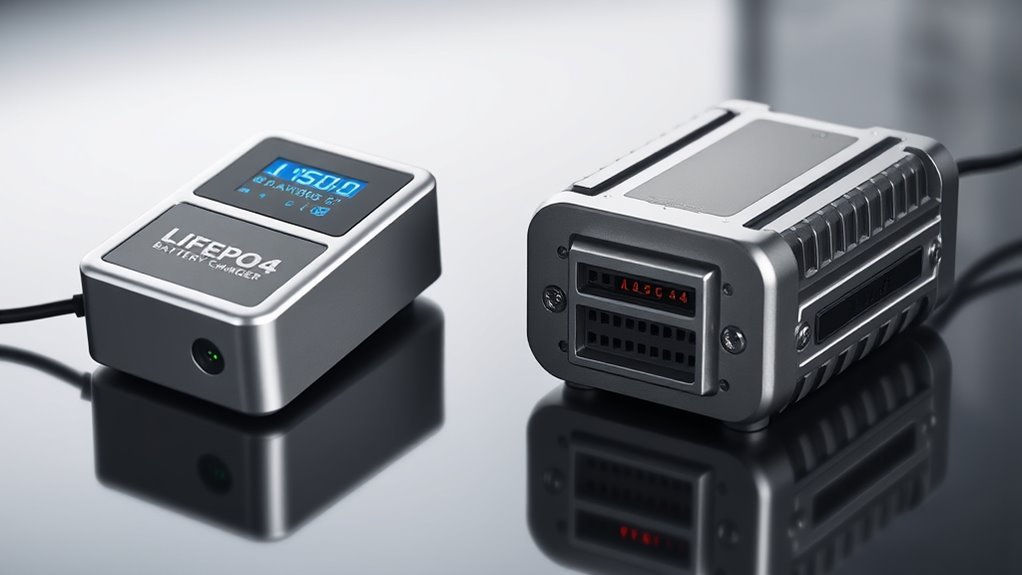
While both LiFePO4 and regular battery chargers serve the fundamental purpose of recharging batteries, their design and operational characteristics differ markedly. The primary distinction lies in battery chemistry, which influences each charger’s design. LiFePO4 batteries require specialized chargers that employ advanced charging algorithms to prevent overcharging and thermal issues, ensuring longevity and safety. These algorithms involve multi-stage processes like bulk, absorption, and float charging tailored specifically for LiFePO4 chemistry. In contrast, regular chargers are designed for lead-acid or other chemistries and often use simpler algorithms, lacking the precision needed for LiFePO4 cells. This difference in charging algorithms makes LiFePO4 chargers more efficient, safer, and better suited to maintaining *ideal* battery health over time.
Why Is Compatibility Important When Choosing a Lifepo4 Charger?
Choosing a compatible LiFePO4 charger is vital because the success of the charging process depends on the charger’s ability to match the specific electrical and chemical requirements of the battery. Compatibility guarantees ideal performance, extends battery life, and minimizes risks like overcharging or overheating. Improper chargers can lead to reduced efficiency and increased waste, impacting battery recycling efforts and the environment. A mismatch may cause early battery degradation, necessitating premature disposal and increasing environmental impact.
| Compatibility Benefits | Risks of Incompatibility |
|---|---|
| Longer battery lifespan | Reduced efficiency and performance |
| Safer operation | Increased safety hazards |
| Eco-friendly disposal | Greater environmental footprint |
What Features Should I Look for in a Lifepo4 Battery Charger?
When selecting a Lifepo4 battery charger, we prioritize charging speed and efficiency to minimize downtime while maintaining battery health. Compatibility and safety features are essential to prevent damage and guarantee reliable operation across different battery models. Additionally, a user-friendly interface simplifies setup and monitoring, making operational control more precise and accessible.
Charging Speed and Efficiency
What specific features should we prioritize to maximize charging speed and efficiency in a Lifepo4 battery charger? First, advanced current regulation guarantees rapid charging without overheating. Second, intelligent algorithms optimize charge cycles, reducing time and energy loss. Third, compatibility with charging station integration allows seamless connection with solar power or grid sources, enhancing overall efficiency. Fourth, incorporating battery recycling protocols minimizes waste and prolongs battery lifespan, supporting sustainable practices. These features collectively improve charging speed while maintaining safety and efficiency. Prioritizing precise current control and smart management algorithms ensures minimal energy waste. Efficient integration with charging infrastructure not only accelerates charging but also supports eco-friendly initiatives, making it essential to evaluate these technical aspects when selecting a Lifepo4 charger.
Compatibility and Safety Features
Ensuring compatibility and safety in a Lifepo4 battery charger involves scrutinizing specific technical features that guarantee reliable operation and user protection. Key considerations include verifying that the charger’s circuitry supports the battery chemistry to prevent overcharging or thermal issues. Additionally, the charger should integrate safety features such as automatic shutoff, short-circuit protection, and temperature regulation. Proper compatibility with the charging infrastructure ensures seamless integration and reduces risk. To visualize, consider:
| Feature | Purpose |
|---|---|
| Battery chemistry recognition | Prevents incompatible charging methods |
| Overcharge and thermal protection | Ensures safety during operation |
| Voltage and current regulation | Maintains stable charging conditions |
| Safety certifications | Validates adherence to safety standards |
User-Friendly Interface
A user-friendly interface in a Lifepo4 battery charger markedly enhances usability by providing clear, intuitive controls and informative displays. This simplifies charger operation, reduces errors, and supports efficient charger maintenance. Key features to look for include:
- Digital displays showing real-time voltage, current, and state of charge for accurate monitoring.
- Automated modes for different battery capacities and chemistries, streamlining setup.
- Error alerts to notify users of issues like improper connections or overheating, promoting safety.
- Maintenance prompts that remind users about battery recycling procedures and routine checks, ensuring longevity. Such features facilitate a better user experience while optimizing performance and safety, essential for responsible battery recycling and minimizing operational downtime.
How Do Charging Rates and Cycles Impact Lifepo4 Battery Life?
Charging rates directly influence battery temperature and stress, which can accelerate capacity fade over time. High cycle counts wear down the electrode materials, reducing overall lifespan if not managed properly. Implementing ideal charging practices is essential to balance speed and longevity, ensuring the battery maintains performance over its intended cycles.
Charging Speed Effects
Since charging rates directly influence battery lifespan, understanding how different speeds and cycling patterns affect Lifepo4 batteries is essential. Faster charging can improve efficiency but risks increased heat generation, which accelerates capacity fade. To optimize battery lifespan, consider these key factors:
- High charging speeds may reduce overall battery life due to thermal stress.
- Slower, controlled charging enhances longevity by minimizing heat buildup.
- Frequent rapid charges can degrade cell chemistry, shortening cycle life.
- Balancing charging speed with thermal management preserves capacity and performance.
Cycle Count Durability
While the rate at which a Lifepo4 battery undergoes charge cycles considerably influences its overall lifespan, the interplay between charging speed and cycle count warrants careful consideration. Frequent cycling accelerates capacity fade, but slower, controlled charging can extend cycle durability. Elevated charging temperatures accelerate degradation, reducing cycle life, while ideal temperatures preserve battery health. Proper management of charging temperature not only enhances cycle count durability but also facilitates easier battery recycling at end-of-life, reducing environmental impact. Rapid charging, often associated with higher cycle counts, may induce thermal stress, diminishing longevity. Conversely, moderate charging rates promote stable cycling and prolong overall lifespan. Understanding these factors helps optimize lifespan and sustainability, ensuring batteries remain functional longer and are more environmentally friendly through effective battery recycling processes.
Optimal Charging Practices
Optimizing the charging process for Lifepo4 batteries involves carefully balancing charging rates with cycle management to maximize longevity. High charging rates can accelerate capacity fade, reducing overall lifespan, while excessively slow rates may prolong charge time but improve cycle stability. Proper cycle management minimizes deep discharges, which are detrimental over time. Key practices include:
- Maintaining moderate charging currents aligned with manufacturer specifications.
- Limiting depth of discharge to preserve cell integrity.
- Incorporating regular partial cycles to extend cycle life.
- Prioritizing renewable energy sources to support sustainable battery recycling efforts.
Which Applications Benefit Most From Using Lifepo4 Chargers?
Lifepo4 chargers are particularly advantageous in applications requiring high safety standards, long cycle life, and reliable performance. They are ideal for electric vehicles, renewable energy storage, and off-grid power systems, where safety and durability are critical. These chargers support sustainable practices by facilitating battery recycling, reducing waste, and extending battery lifespan. Their stable chemistry minimizes environmental impact, making them suitable for large-scale deployment in environmentally sensitive areas. Additionally, Lifepo4 batteries’ inherent safety features lessen the risk of thermal runaway, ensuring safer operation in critical applications. Overall, industries focused on sustainability, safety, and efficiency benefit most from using Lifepo4 chargers, aligning technological performance with eco-conscious goals and long-term operational reliability.
What Common Mistakes Should You Avoid When Charging Lithium Iron Phosphate Batteries?
Proper charging practices are essential to maintaining the longevity and safety of Lithium Iron Phosphate (LiFePO4) batteries. Avoiding common mistakes in battery maintenance and following correct charging protocols can prevent damage and guarantee peak performance. Key errors include:
Proper charging ensures LiFePO4 battery durability and safety by avoiding common maintenance mistakes.
- Using inappropriate chargers that lack the necessary voltage and current regulation for LiFePO4 chemistry.
- Overcharging beyond the recommended voltage, leading to capacity loss and potential safety hazards.
- Disregarding temperature conditions, which can impair chemical stability and reduce battery lifespan.
- Ignoring proper balance charging, resulting in uneven cell voltage and compromised battery integrity.
Adhering to proper charging protocols minimizes risks and prolongs battery life, making it crucial to follow manufacturer guidelines and avoid shortcuts in the charging process.
How Do I Choose the Best Charger for My Lifepo4 Battery System?
Choosing the right charger for your LiFePO4 battery system requires careful consideration of several technical factors to guarantee safety, efficiency, and longevity. Key considerations include the charger’s voltage and current ratings aligned with your battery’s specifications, ensuring optimal charge cycles and preventing overcharging. Battery maintenance is enhanced with chargers that incorporate sophisticated charge indicators, providing real-time data on state-of-charge and health status. An effective charger should feature automatic cut-off and temperature regulation to mitigate risks of thermal runaway. Compatibility with LiFePO4 chemistry is essential, as regular chargers may lack the necessary voltage profiles and safety features. Selecting a charger with precise control and clear charge indicators ensures efficient, safe, and reliable operation, extending your battery’s service life.
Can I Use a Regular Charger on My Lifepo4 Batteries?
Using a regular charger on LiFePO4 batteries is generally not advisable because these batteries require specific charging profiles that differ considerably from standard lead-acid or nickel-based chemistries. LiFePO4 cells demand precise voltage and current regulation to guarantee safety and longevity. Using an unsuitable charger can lead to overcharging, thermal runaway, or damage, complicating battery recycling processes later. Additionally, a proper charging station tailored for LiFePO4 ensures ideal charge cycles, preserving capacity over time.
Key considerations include:
- Incompatibility with the battery’s voltage profile
- Risk of damaging internal chemistry
- Potential safety hazards
- Impact on long-term battery health and recycling efficiency
Always opt for chargers designed specifically for LiFePO4 to maintain system integrity and safety.
What Are the Safety and Cost Benefits of Using a Lifepo4 Charger?
A dedicated LiFePO4 charger offers significant safety and cost advantages by ensuring ideal charging conditions tailored specifically to the battery chemistry. Proper battery thermal management minimizes overheating risks, reducing the likelihood of thermal runaway and extending battery lifespan. This targeted approach enhances operational safety and reduces maintenance costs over time. Additionally, a compatible charger typically comes with an extended charger warranty, reflecting confidence in its design and reliability. Using a LiFePO4-specific charger prevents overcharging and deep discharge, lowering replacement expenses. The precise control over charging parameters also optimizes efficiency, saving energy costs. Overall, these safety features and durability benefits make investing in a dedicated LiFePO4 charger a cost-effective choice for long-term performance and peace of mind.
Frequently Asked Questions
How Long Does It Take to Fully Charge a Lifepo4 Battery?
We find that fully charging a LiFePO4 battery typically takes around 3 to 5 hours, depending on its capacity and the charger’s charging speed, which influences the overall efficiency and time required for ideal battery performance.
Are Lifepo4 Chargers More Energy-Efficient Than Regular Chargers?
Think of efficiency as a well-oiled machine—Lifepo4 chargers excel in energy conservation, leveraging advanced battery technology and charging safety measures, making them more energy-efficient than regular chargers, ultimately reducing waste and optimizing power usage.
Can Lifepo4 Chargers Be Used in Cold Weather Conditions?
We find that Lifepo4 chargers can operate in cold weather, but charger performance may decline without proper temperature management. Cold conditions can slow charging efficiency and impact battery longevity, so specialized features optimize performance in low temperatures.
Do Lifepo4 Batteries Require Maintenance During Charging?
We don’t need to perform extensive maintenance on LiFePO4 batteries during charging; however, monitoring voltage regulation and periodic battery calibration helps guarantee ideal performance and longevity, preventing overcharge or undercharge conditions that could degrade the battery.
What Is the Typical Lifespan of a Lifepo4 Charger?
We find that Lifepo4 chargers typically last around 8-10 years, contrasting with the fewer charging cycles of traditional chargers. This longevity reflects advanced battery technology, ensuring reliability despite frequent charging, which optimizes lifespan and performance over time.
Conclusion
In summary, selecting the right charger for our LiFePO4 batteries is vital—it’s like choosing the correct key to access optimal performance and safety. Regular chargers are ill-suited, risking damage like a mismatched puzzle piece. By understanding the differences and features, we guarantee our batteries last longer and operate safely. Investing in a dedicated LiFePO4 charger isn’t just smart; it’s necessary for maintaining the integrity and longevity of our power systems.