While some may assume all lithium batteries are fundamentally the same, the differences in chemistry profoundly affect performance, safety, and application suitability. Understanding the nuances between LCO, LFP, and NMC chemistries is essential for making informed choices in technology development and deployment. We’ll explore these key distinctions, revealing how each chemistry’s unique properties impact longevity, environmental sustainability, and real-world use cases—an insight that’s critical for optimizing battery design and safety.
Key Takeaways
- Different chemistries like LCO, LFP, and NMC balance energy density, safety, lifespan, and environmental impact for specific applications.
- Lithium-ion batteries operate via lithium-ion movement between graphite anodes and metal oxide cathodes.
- Lithium-polymer batteries offer design flexibility, improved safety, and are suited for space-constrained devices.
- Safety features include thermal management, robust enclosures, and material stability to prevent overheating and failures.
- Future trends focus on solid-state batteries, higher capacity anodes, and sustainable manufacturing to enhance performance and safety.
What Are the Main Types of Lithium Battery Chemistries?
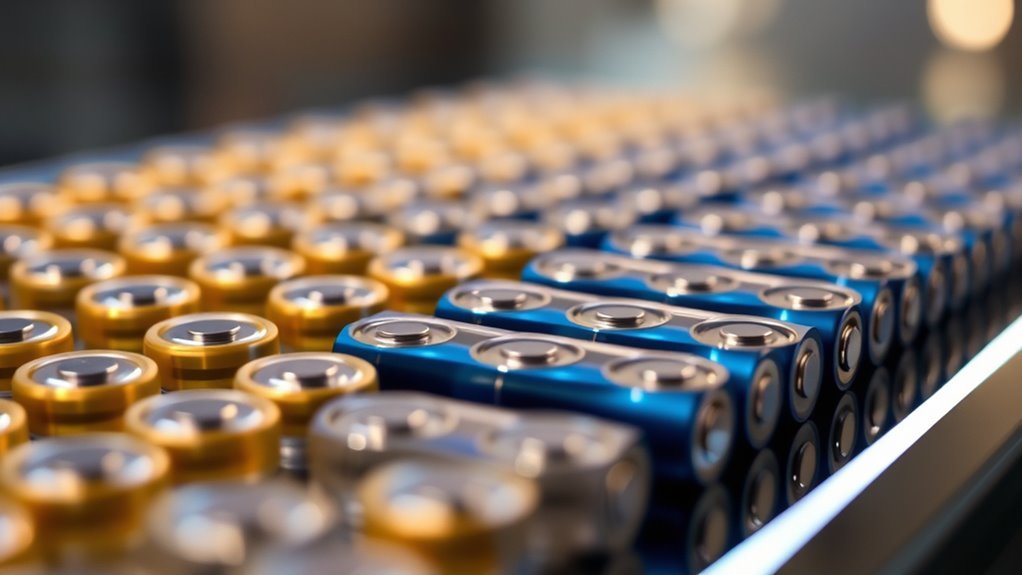
Lithium battery chemistries are defined by the specific materials used for the cathode, anode, and electrolyte, which directly influence their performance characteristics. The main types include lithium cobalt oxide (LCO), lithium iron phosphate (LFP), and lithium nickel manganese cobalt oxide (NMC). Each chemistry offers distinct benefits and challenges related to energy density, cycle life, and safety. For instance, LFP batteries excel in longevity and safety, making them suitable for stationary storage, while NMC balances energy density and durability. Environmental impact and battery recycling are vital considerations, as different chemistries vary in recyclability and potential toxicity. Understanding these types enables us to evaluate not only performance but also sustainability, ensuring responsible use and disposal of lithium batteries.
How Lithium-Ion Batteries Work and Their Uses
Lithium-ion batteries operate through the movement of lithium ions between the anode and cathode within a structured electrochemical cell, enabling efficient energy transfer. Their compact design and high energy density make them ideal for a wide range of applications, from portable electronics to electric vehicles. Understanding their structure and function reveals why these batteries offer significant benefits such as longevity, fast charging, and lightweight performance.
Battery Structure and Function
Understanding how lithium-ion batteries function requires examining their core structure and operational principles. At their core, lithium-ion batteries consist of electrode materials—the anode typically made from graphite and the cathode from metal oxides—and an electrolyte composition that facilitates ion transfer. During operation, lithium ions move between the electrodes through the electrolyte during charge and discharge cycles. The electrode materials determine capacity and voltage, while the electrolyte’s composition guarantees efficient ionic conductivity and stability. The separator prevents electrical contact between electrodes, maintaining safety and efficiency. This integrated structure enables high energy density and long cycle life. Analyzing these components reveals how precise material selection and electrolyte formulation critically influence battery performance, safety, and longevity.
Common Applications and Benefits
Have you ever wondered why lithium-ion batteries have become the dominant energy storage technology across various sectors? Their versatility stems from high energy density, lightweight design, and efficient charge/discharge cycles. Key applications include:
- Portable electronics, enabling compact, long-lasting devices.
- Electric vehicles, reducing greenhouse emissions and dependence on fossil fuels.
- Renewable energy storage, balancing supply and demand.
- Grid stabilization, supporting sustainable infrastructure.
Despite these benefits, the environmental impact remains a concern, especially regarding raw material extraction and disposal. Recycling processes are vital to mitigate ecological effects by recovering valuable materials like lithium and cobalt. Advancements in recycling technologies not only reduce waste but also lessen the demand for environmentally intensive mining, making lithium-ion batteries more sustainable in the long term.
Why Use Lithium-Polymer Batteries? Pros and Cons
Lithium-polymer batteries offer significant advantages in device design flexibility due to their thin, lightweight form factors, enabling innovative form factors. They also present potential safety benefits, as their solid or gel-like electrolytes reduce risks associated with leakage or thermal runaway. Evaluating these benefits alongside their limitations is essential for understanding their best applications.
Flexibility in Device Design
The unique form factor and adaptable shape of lithium-polymer batteries enable innovative device designs that traditional batteries cannot easily accommodate. Their flexibility in device design stems from the use of flexible electrode materials and the ability to create modular battery packs, which allow for tailored configurations. This flexibility supports compact, lightweight, and unconventional form factors.
- Design Versatility: Enables thin, curved, or irregular shapes for diverse applications.
- Enhanced Integration: Facilitates seamless incorporation into wearable and portable devices.
- Scalability: Modular battery packs allow for scalable power solutions tailored to specific needs.
- Manufacturing Efficiency: Simplifies manufacturing processes by reducing the need for complex packaging.
This technical advantage makes lithium-polymer batteries highly suitable for innovative, space-constrained device designs.
Potential for Enhanced Safety
While lithium-polymer batteries offer notable safety advantages, their potential for enhanced safety hinges on their chemical stability and structural design. The use of solid or gel-like electrolytes improves electrolyte stability, reducing the risk of leakage and flammability compared to liquid electrolytes. This structural stability minimizes the likelihood of internal short circuits that can trigger thermal runaway, a critical safety concern in lithium-ion batteries. Additionally, the flexible form factor allows for safer packaging and better containment of internal components. However, despite these benefits, lithium-polymer batteries are not immune to safety issues, especially under conditions of high stress or damage. Overall, their improved electrolyte stability and design features provide a tangible safety margin, making them a preferable choice in safety-critical applications.
What Are Solid-State Lithium Batteries and Why Are They Promising?
- Higher energy density due to closer ion pathways in solid electrolytes.
- Improved thermal stability, reducing overheating risks.
- Longer cycle life by minimizing electrolyte degradation.
- Enhanced safety profile, especially against leaks or combustion.
These attributes make *solid-state* batteries promising for future applications, especially where safety is paramount. Their potential to deliver both increased performance and safety has driven research, positioning them as a pivotal innovation in lithium battery chemistry.
Battery Performance: Capacity, Safety, and Longevity
Advancements in lithium battery chemistry directly impact their capacity, safety, and longevity, which are critical metrics for evaluating performance. Higher capacity guarantees longer usage between charges, while safety improvements reduce risks like thermal runaway. Longevity, influenced by electrode stability, determines battery lifespan. The table below summarizes key aspects:
| Chemistry Type | Capacity (mAh/g) | Safety Measures | Longevity (cycles) |
|---|---|---|---|
| Lithium Cobalt Oxide (LCO) | Moderate | Moderate, thermal risks | 300–500 |
| Lithium Iron Phosphate (LiFePO₄) | High | Superior, stable chemistry | 2000+ |
| Lithium Nickel Manganese Cobalt (NMC) | High | Improved safety features | 1000–2000 |
Environmental impact and battery recycling considerations influence chemistry choices, affecting sustainable performance improvements.
Which Lithium Battery Chemistry Is Best for Electric Vehicles?
Selecting the most suitable lithium battery chemistry for electric vehicles hinges on balancing energy density, safety, and lifespan. Lithium Nickel Manganese Cobalt Oxide (NMC) offers high energy density and good thermal stability, making it a popular choice. Lithium Iron Phosphate (LiFePO₄) prioritizes safety and cycle life, though with lower energy density. Lithium Cobalt Oxide (LCO) provides excellent energy density but poses safety concerns and challenges in battery recycling.
Key considerations include:
- Energy density—affects vehicle range and performance.
- Safety profile—critical for consumer confidence and accident resilience.
- Environmental impact—recyclability influences sustainability.
- Lifecycle and recycling—longer lifespan reduces waste and resource consumption.
How Much Do Lithium Batteries Cost and How Are They Made?
The cost of lithium batteries considerably influences the overall price of electric vehicles and determines their market adoption. Manufacturing costs depend on raw materials, processing, and scale, with lithium extraction and refining being primary contributors. Recycling lithium-ion batteries reduces raw material demand, lowering costs and mitigating environmental impact. The production process involves electrode fabrication, cell assembly, and electrolyte filling, all requiring precision to guarantee performance and safety.
| Cost Factors | Environmental Impact |
|---|---|
| Raw material sourcing | Mining-related pollution |
| Battery recycling | Reduces waste, conserves resources |
| Manufacturing scale | Lower costs, fewer emissions |
| Supply chain efficiency | Minimizes environmental footprint |
Ultimately, advancements in battery recycling and sustainable manufacturing are vital for cost reduction and reducing environmental effects.
What Safety Factors Should You Consider With Lithium Batteries?
Given the high energy density and chemical reactivity of lithium batteries, ensuring safety is paramount. Critical safety factors include:
- Thermal management: Proper regulation prevents overheating, which can lead to thermal runaway or fires.
- Mechanical stability: Structural integrity reduces risks of internal short circuits caused by physical damage.
- Electrochemical stability: Ensuring stable operating voltages minimizes degradation and potential hazards.
- Battery enclosure design: Robust casing contains potential leaks or ruptures, preventing exposure to reactive components.
Addressing these factors involves careful design and material selection to mitigate risks associated with thermal and mechanical failures, ultimately safeguarding both users and equipment.
Future Trends in Lithium Battery Technology and Development
Advancements in lithium battery technology are driving the development of more efficient, safer, and higher-capacity energy storage solutions. Future trends include integrating solid-state electrolytes, which enhance safety and energy density, and exploring lithium-silicon anodes for increased capacity. Quantum computing is poised to accelerate battery material discovery through complex simulations, optimizing electrode and electrolyte performance. Additionally, as renewable energy sources expand, lithium batteries will play a critical role in grid stabilization and energy storage, requiring innovations to improve cycle life and scalability. These developments aim to address the needs of high-demand applications, such as electric vehicles and grid storage, emphasizing the importance of materials science and computational modeling. Overall, the trajectory points toward smarter, more sustainable batteries aligned with emerging technological and energy systems.
Frequently Asked Questions
How Do Temperature Variations Affect Different Lithium Battery Chemistries?
Temperature variations impact lithium battery chemistries differently; we observe that temperature stability considerably influences chemistry performance, with some chemistries degrading quickly in heat or cold, affecting overall efficiency and lifespan.
What Recycling Methods Are Most Effective for Lithium Batteries?
Like a savvy coder, we find that effective recycling techniques involve hydrometallurgical and pyrometallurgical methods, optimizing battery disposal processes to recover valuable materials and minimize environmental impact, ensuring sustainable lithium battery lifecycle management for future innovations.
Are There Environmental Concerns Associated With Specific Lithium Chemistries?
Yes, environmental concerns vary with lithium chemistries; for instance, cobalt-based batteries pose toxicity risks, while lithium iron phosphate offers longer battery lifespan and lower material toxicity, making them more sustainable options regarding environmental impact and lifecycle.
How Do Manufacturing Processes Differ Among Lithium Battery Types?
We find that manufacturing processes vary considerably among lithium battery types; for example, electrode materials and electrolyte stability requirements influence production complexity, with advanced chemistries demanding precision to guarantee safety, performance, and scalability in their manufacturing methods.
What Are the Challenges in Scaling up Solid-State Lithium Battery Production?
Solid-state challenges in scaling production include maintaining uniform electrolyte interfaces, ensuring manufacturing precision, and controlling material purity, which are critical for consistent performance and safety, ultimately affecting production scalability and widespread adoption in high-demand applications.
Conclusion
As we navigate the landscape of lithium chemistries, each type serves as a different brushstroke in a complex masterpiece—balancing safety, capacity, and longevity. Like a compass guiding us through a dense forest, understanding these distinctions sharpens our decisions. Ultimately, selecting the right chemistry aligns our technological ambitions with sustainable, reliable energy solutions—illuminating the path forward in this evolving field.