It’s no coincidence that many lithium battery failures often trace back to overlooked maintenance routines. As professionals, we recognize that a systematic preventive schedule is essential for ensuring safety, performance, and long-term reliability. Properly structured, this routine minimizes risks and extends battery lifespan, but establishing an effective plan requires careful consideration of inspection, testing, and handling procedures. Understanding these critical components can considerably impact operational efficiency—so, let’s explore how a tailored maintenance schedule can make a difference.
Key Takeaways
- Conduct visual inspections monthly to check for corrosion, swelling, cracks, or leaks, and ensure terminals are clean and tight.
- Measure voltage and temperature regularly, using calibrated sensors, to detect early signs of degradation or overheating.
- Schedule capacity tests every 6 to 12 months, discharging batteries at 0.2C-0.5C within controlled temperature conditions.
- Follow proper charging protocols, avoiding deep discharges below 20% and limiting full charges to 80-90%.
- Store batteries in cool, dry environments, and handle with PPE to ensure safety and prolong lifespan.
Why Regular Maintenance Is Essential for Lithium Batteries
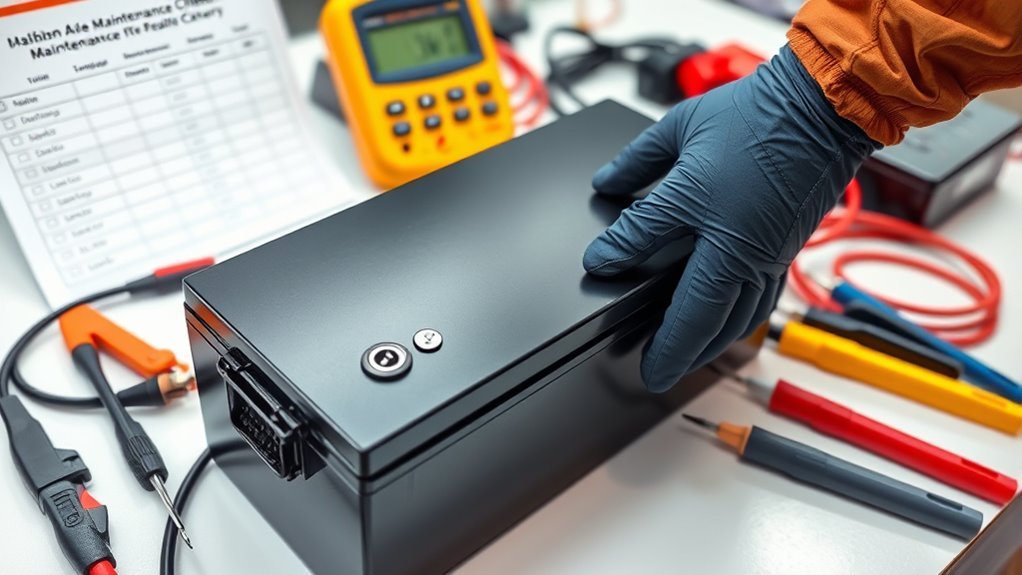
Regular maintenance is crucial for lithium batteries because it directly impacts their lifespan, safety, and performance. Proper management minimizes the risk of failure and extends usable life, reducing the frequency of replacements. An essential aspect is battery recycling, which prevents hazardous waste and lessens environmental impact. By ensuring batteries are correctly disposed of or repurposed, we mitigate toxic material leakage and conserve resources. Regular checks help identify early signs of degradation, preventing catastrophic failures that could pose safety hazards. Maintaining ideal conditions also supports sustainable practices by promoting recycling efforts and decreasing environmental footprint. Overall, consistent maintenance not only enhances operational reliability but also aligns with ecological responsibility, emphasizing the importance of systematic care for lithium batteries within a broader sustainability framework.
How to Perform Visual Inspections and Detect Potential Issues
Performing thorough visual inspections is a key step in maintaining lithium battery health, as it allows us to identify early signs of potential issues before they escalate. During inspections, we focus on specific visual cues that indicate problems.
Thorough visual inspections help identify early signs of lithium battery issues, preventing escalation and ensuring safety.
- Check for corrosion: Look for white or greenish deposits around terminals and connectors, signaling corrosion.
- Inspect for swelling or bulging: Any deformation suggests internal damage or overcharging.
- Examine terminals and connectors: Ensure they are clean, tight, and free of debris or corrosion.
- Assess casing integrity: Look for cracks, leaks, or discoloration, which can compromise safety and performance.
Detecting corrosion early and recognizing physical anomalies are essential for effective preventive maintenance.
Monitor Battery Temperature and Voltage for Safety
Monitoring battery temperature and voltage is essential for guaranteeing safety and ideal performance, as fluctuations can indicate underlying issues or potential failures. Consistent thermal regulation relies on accurately tracking temperature to prevent overheating that could compromise battery insulation or trigger thermal runaway. Voltage monitoring helps detect abnormal charge or discharge patterns, signaling potential cell imbalance or degradation. Elevated temperatures may suggest compromised insulation or inadequate thermal regulation, increasing risk of failure. Conversely, low temperature readings can impair chemical reactions, reducing efficiency. By continuously analyzing these parameters, we can preemptively identify issues before they escalate. Proper sensor calibration and data logging are critical for precise monitoring. This proactive approach ensures maximum operation, prolongs battery lifespan, and mitigates safety hazards associated with thermal or electrical anomalies.
Set Up a Charging and Discharging Routine
We need to establish an ideal charging frequency to prevent capacity fade and guarantee longevity. Monitoring discharge levels allows us to avoid deep discharges that can harm the battery’s health. Implementing a precise routine helps maintain consistent performance and prolongs battery life.
Establish Charging Frequency
How often should lithium batteries be charged and discharged to optimize their lifespan? Establishing appropriate charging intervals is crucial for prolonging battery lifespan. Typically, we recommend:
- Charging before reaching 20% capacity to prevent deep discharge stress.
- Avoiding full charges exceeding 80-90% to reduce strain on the battery’s chemistry.
- Limiting frequent partial charges, ideally maintaining a range between 30-80%.
- Scheduling regular, moderate discharges—about once a month—to recalibrate the battery’s capacity.
Consistent adherence to these charging intervals minimizes stress, reduces capacity fade, and maintains optimal performance. Properly set charging frequency ensures the battery’s longevity and efficiency, preventing premature degradation caused by overcharging or deep discharges.
Monitor Discharge Levels
What is the most effective way to establish a reliable charging and discharging routine for lithium batteries? Consistent discharge monitoring and level tracking are essential. Regularly observing voltage and capacity fluctuations helps prevent over-discharge and deep cycling, which degrade battery health. Implementing a structured routine involves setting thresholds for minimum capacity and maximum voltage, ensuring batteries stay within ideal ranges. To clarify, consider this table:
| Discharge Level | Monitoring Frequency | Impact on Battery Health |
|---|---|---|
| 20-50% | Weekly | Maintains longevity |
| 50-80% | Bi-weekly | Prevents deep discharge |
| 80-100% | Monthly | Avoids overcharging |
| Below 20% | Immediate check | Prevents damage |
| Above 80% | Monitor closely | Reduces stress on cells |
Accurate level tracking ensures consistent performance and prolongs battery lifespan.
Clean and Store Lithium Batteries Properly
Proper cleaning of lithium batteries involves using non-abrasive, lint-free cloths to remove dirt and corrosion without damaging terminals. Maintaining ideal storage conditions requires keeping batteries in a cool, dry environment with a partial charge to prevent capacity loss. Handling safety precautions, such as wearing protective gear and avoiding punctures, ensures safe maintenance and reduces risk of thermal events.
Proper Cleaning Techniques
To guarantee lithium batteries maintain ideal performance and safety, we must adhere to meticulous cleaning and storage protocols. Proper cleaning involves systematic steps:
- Electrolyte inspection: Check for leaks or swelling, indicating potential damage.
- Connector inspection: Ensure terminals are free of corrosion, dirt, or oxidation.
- Surface cleaning: Use a soft, lint-free cloth lightly dampened with isopropyl alcohol to remove dust or residue, avoiding liquid ingress.
- Drying and reassembly: Allow components to dry thoroughly before reconnecting or sealing to prevent moisture-related issues. These steps prevent electrical faults and maintain chemical stability. Regular electrolyte and connector inspection are vital for early detection of deterioration, guaranteeing safe operation and prolonging battery lifespan.
Optimal Storage Conditions
Maintaining ideal storage conditions is essential for preserving lithium battery performance and safety over time. Optimal storage involves controlling temperature and minimizing exposure to environmental variables that accelerate degradation. Temperatures between 0°C and 25°C are recommended, as fluctuations outside this range can cause capacity loss or safety risks. Proper storage also involves keeping batteries in a dry, ventilated environment, away from direct sunlight and moisture. Consistent temperature control reduces internal stress and maintains chemical stability, prolonging battery life.
| Storage Condition | Recommended Parameter | Rationale |
|---|---|---|
| Temperature | 0°C to 25°C | Minimize capacity fade and safety risks |
| Humidity | Below 60% RH | Prevent corrosion and damage |
| Ventilation | Adequate airflow | Avoid heat buildup |
| Storage Duration | Up to 6 months | Prevent capacity degradation |
Handling Safety Precautions
Handling lithium batteries safely begins with guaranteeing they are clean and stored correctly to prevent hazards such as short circuits, leakage, or fire. Proper handling involves strict safety protocols, including the use of personal protective equipment (PPE) such as gloves and eye protection. Additionally, we must prepare for emergency response scenarios by having fire extinguishers suitable for lithium fires nearby. To maintain safety:
- Clean battery terminals with non-conductive, approved materials to prevent accidental short circuits.
- Store batteries in a cool, dry environment, away from flammable materials.
- Handle batteries with insulated tools to avoid accidental conduction.
- Always follow manufacturer guidelines and have emergency response plans in place.
Adhering to these precautions minimizes risk and ensures safe maintenance practices.
When and How to Test Battery Capacity
Regularly testing battery capacity is essential to guarantee peak performance and longevity of lithium batteries. Conducting capacity testing at scheduled intervals allows us to verify the battery’s actual capacity against its rated value, assuring proper battery calibration. Typically, capacity testing should occur after every 6 to 12 months of operation, depending on usage conditions. This process involves discharging the battery under controlled conditions and measuring the actual capacity. The following table summarizes testing parameters:
| Test Parameter | Typical Value | Purpose |
|---|---|---|
| Discharge Rate | 0.2C to 0.5C | Standardized capacity assessment |
| Cut-off Voltage | Manufacturer Spec | Defines end of capacity test |
| Temperature | 20-25°C | Ensures consistent results |
This systematic approach helps identify capacity declines early, supporting maintenance decisions.
Troubleshoot Common Lithium Battery Problems
When lithium batteries exhibit performance issues, systematic troubleshooting becomes essential to identify and resolve the underlying problems efficiently. First, check for voltage irregularities that suggest cell imbalance or degradation. Second, inspect connections for corrosion or loose terminals, which can impair performance. Third, analyze temperature data; overheating indicates thermal management issues. Fourth, review manufacturer warranties and recycling guidelines—worn batteries should be recycled responsibly to prevent environmental harm and guarantee proper disposal. Troubleshooting also involves verifying that the battery’s state of health aligns with manufacturer specifications. Addressing these issues promptly helps maintain peak performance, prolongs battery lifespan, and ensures compliance with recycling protocols. Understanding the root causes allows us to implement targeted repairs or replacements, minimizing downtime and preserving system reliability.
Create a Maintenance Schedule Tailored to Your Battery System
Creating an effective maintenance schedule for your lithium battery system requires a thorough understanding of its specific operational parameters and usage patterns. We analyze factors such as charge cycles, operating temperature, and load demands to optimize maintenance intervals. Tailoring the schedule minimizes degradation, prolongs battery lifespan, and reduces environmental impact through proper disposal and battery recycling procedures. Regular monitoring ensures early detection of capacity loss or performance issues, enabling timely interventions. Incorporating environmental considerations, like recycling spent batteries, aligns maintenance practices with sustainability goals. A data-driven approach enhances reliability while minimizing waste and ecological footprint. By customizing maintenance routines based on actual usage, we ensure efficient operation and responsible end-of-life management, supporting both system performance and environmental stewardship.
Key Components of an Effective Lithium Battery Maintenance Plan
An effective lithium battery maintenance plan hinges on several key components that guarantee ideal performance and longevity. First, consistent monitoring of voltage and temperature guarantees early detection of potential failures. Second, implementing proper charging protocols prevents overcharging or deep discharging, extending battery life. Third, sourcing high-quality lithium through responsible lithium sourcing and ensuring proper disposal via battery recycling minimizes environmental impact and maintains supply chain sustainability. Fourth, regular inspection of terminals and connections prevents corrosion and guarantees electrical integrity. These measures collectively optimize battery health, reduce downtime, and support sustainable practices. Incorporating these components into your maintenance strategy guarantees reliable operation while aligning with industry standards for lithium sourcing and responsible battery recycling.
Frequently Asked Questions
What Are the Signs of Imminent Lithium Battery Failure?
We notice signs of imminent lithium battery failure through rapid capacity loss, increased internal resistance, unusual heating, and inconsistent charging protocols. Battery degradation accelerates, indicating we should evaluate performance metrics promptly to prevent sudden failure.
How Do Environmental Conditions Affect Battery Maintenance Needs?
We investigate how environmental factors, especially battery temperature, influence maintenance needs, revealing that extreme temperatures accelerate degradation. Proper thermal management guarantees ideal performance and longevity, emphasizing the importance of monitoring environmental conditions to prevent premature battery failure.
Can Maintenance Extend the Lifespan of a Lithium Battery Significantly?
Yes, maintenance extends lithium battery lifespan by optimizing charge cycles and promoting proper battery recycling practices, reducing degradation. Regular checks and balanced charging protocols minimize capacity loss, ensuring longer, more reliable operation over the battery’s functional life.
What Safety Precautions Are Necessary During Maintenance Procedures?
During maintenance, we always wear Personal Protective Equipment like gloves and goggles; for example, in a case study, PPE prevented injury. We also prepare for emergency response, ensuring safety protocols are clear and accessible.
How Often Should Battery Electrolyte Levels Be Checked?
We recommend electrolyte monitoring at maintenance intervals of every three to six months, depending on usage and environmental conditions. Regular checks guarantee ideal battery performance and longevity, enabling timely intervention before issues compromise safety or efficiency.
Conclusion
While regular maintenance might seem tedious, neglecting it can lead to unexpected failures and costly replacements. Ironically, the very effort we put into routine checks and proper care ultimately safeguards our investments, ensuring safety and longevity. Ignoring these protocols may seem convenient initially, but it increases risks that could have been easily mitigated. In the end, diligent maintenance isn’t just about extending battery life—it’s about avoiding preventable disasters disguised as minor inconveniences.