As we consider energy resilience during winter, lithium battery storage emerges as a critical component, offering high-density power despite seasonal challenges. However, cold weather profoundly impacts performance and lifespan, requiring careful selection, advanced thermal management, and strategic maintenance. Understanding these complexities is essential for optimizing system reliability and efficiency. Exploring these factors further reveals how emerging technologies and best practices can help us address winter’s unique demands on battery systems.
Key Takeaways
- Lithium batteries enhance winter energy security by providing reliable, localized storage during seasonal demand spikes.
- Cold temperatures reduce lithium battery efficiency, necessitating thermal management like insulation and active heating.
- Advanced electrode materials and integrated heating systems improve low-temperature performance and lifespan.
- Proper installation includes insulation and thermal management to maintain optimal operating temperatures in winter.
- Regular maintenance and smart storage practices extend lithium battery lifespan during cold weather conditions.
How Lithium Battery Storage Can Improve Your Winter Energy Security
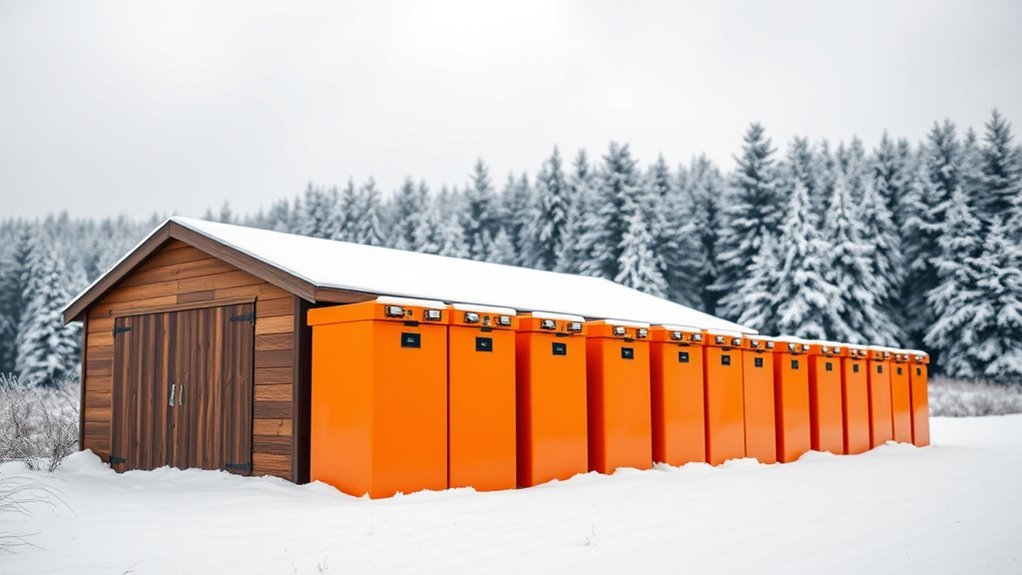
As winter conditions often lead to increased energy demand and potential supply disruptions, lithium battery storage offers a reliable solution to enhance energy security. By facilitating renewable integration, these batteries enable the efficient absorption of excess energy generated from solar and wind sources during periods of low demand, smoothing out fluctuations in power supply. This capability supports a more resilient grid, reducing reliance on traditional fossil fuel sources and minimizing vulnerability during peak winter loads. Additionally, lithium battery systems promote grid independence by providing localized energy storage, ensuring continuous power supply even when external grid conditions are compromised. Overall, integrating lithium batteries strengthens winter energy resilience through improved renewable utilization and reduced dependency on external supply, making energy systems more robust in challenging seasonal conditions.
Why Cold Weather Reduces Lithium Battery Performance and How to Prevent It
Cold weather directly impacts lithium battery performance by reducing the chemical activity within the cells, which diminishes their capacity and efficiency. In cold climates, lower temperatures slow ion mobility, leading to decreased conductivity and increased internal resistance. This results in reduced charge acceptance and discharges, impairing overall system performance. Additionally, sustained exposure to cold accelerates battery degradation, shortening lifespan. The electrolyte’s viscosity increases, further limiting ion flow and hastening capacity fade over time. To mitigate these effects, we recommend thermal management strategies such as insulation, heating systems, or controlled environments to maintain ideal operating temperatures. Proper pre-warming before use and avoiding prolonged cold exposure help preserve battery health, ensuring sustained performance and longevity despite challenging cold climate conditions.
Choosing the Best Lithium Battery System for Winter Conditions
Selecting the most suitable lithium battery system for winter conditions requires careful consideration of design features and specifications that can withstand low temperatures. Key factors include battery capacity, which determines energy availability during cold spells, and charging efficiency, which declines at lower temperatures, impacting recharge times and overall system performance. High-quality systems designed with thermal management optimize capacity retention and maintain efficient charge acceptance in cold climates. We must evaluate batteries with proven low-temperature performance metrics, ensuring minimal capacity loss and high charging efficiency. Additionally, selecting batteries with advanced internal chemistry or integrated heating solutions can further enhance winter resilience. A thorough analysis of these parameters allows us to identify systems that deliver reliable energy storage, maximize capacity, and sustain charging efficiency under winter conditions.
Installing and Maintaining Lithium Batteries in Cold Climates
Installing lithium batteries in cold climates demands careful planning to guarantee peak performance and longevity. Understanding battery chemistry is vital, as different chemistries exhibit varying degrees of cold resilience. Lithium iron phosphate (LiFePO₄) batteries, for instance, typically offer better cold resilience compared to other chemistries, maintaining higher capacity and efficiency at low temperatures. Proper installation involves guaranteeing adequate insulation and thermal management systems to prevent temperature drops that could impair performance. Regular maintenance includes monitoring voltage and state of charge, especially during winter months, to prevent issues like over-discharge. Additionally, employing heating solutions or enclosure designs that retain heat helps sustain ideal operating temperatures. By addressing these factors, we can safeguard battery health and secure reliable power storage throughout winter conditions.
Lithium vs. Other Backup Options for Winter Power
While lithium batteries have become increasingly popular for winter power backup, they are not the only viable option. Alternatives like lead-acid, flow batteries, and thermal storage systems each possess unique advantages. Lead-acid batteries offer affordability and established recycling infrastructure but have lower energy density, limiting capacity in compact setups. Flow batteries provide scalability and longer cycle life, with easier battery recycling at end-of-life, though they tend to be more expensive upfront. Thermal storage systems can supplement electrical backup but lack the versatility of chemical batteries. When comparing options, energy density plays a critical role, influencing size and weight constraints. Lithium batteries excel here, but considering recycling processes and overall system integration is essential for selecting the most reliable, sustainable winter backup solution.
Maximizing Battery Performance During Winter Power Outages
To guarantee lithium batteries perform at their best during winter power outages, it’s essential to implement strategies that address cold weather impacts on chemistry and capacity. Cold temperatures reduce ion mobility, decreasing overall efficiency. To mitigate this:
- Maintain appropriate charger compatibility by using chargers designed for low-temperature operation to prevent voltage drops.
- Regularly perform battery recycling to remove degraded cells, ensuring optimal capacity and longevity.
- Incorporate thermal management systems, such as insulation or active heating, to sustain an ideal operating temperature range, preserving capacity and performance.
Implementing these strategies ensures batteries retain their capacity and efficiency, even in harsh winter conditions. Proper maintenance and compatible charging equipment are vital, as they prevent premature degradation and maximize energy output during outages.
Costs and Incentives for Winter-Ready Lithium Battery Storage
Investing in winter-ready lithium battery storage involves evaluating both the initial costs and the financial incentives available to offset those expenses. A detailed cost analysis reveals that battery chemistry substantially impacts overall costs, as lithium-ion chemistries like NMC or LFP vary in price and lifespan. Although advanced chemistries may carry higher upfront costs, they often provide better performance in cold temperatures, reducing long-term maintenance expenses. Incentive programs, such as tax credits or rebates, can greatly lower net investment costs, making winter-ready systems more accessible. Ultimately, balancing upfront expenditure against expected performance and available incentives requires a precise understanding of battery chemistry and thorough cost analysis to optimize economic viability and system resilience in cold conditions.
Troubleshooting Common Lithium Battery Issues in Cold Weather
Cold weather can markedly impair lithium battery performance, causing issues such as reduced capacity, increased internal resistance, and potential system shutdowns. These problems stem from the temperature-dependent nature of battery chemistry, which slows electrochemical reactions at low temperatures. Troubleshooting begins with evaluating thermal insulation strategies, which help maintain suitable operating temperatures.
- Evaluate thermal insulation: Proper insulation minimizes heat loss and sustains battery chemistry efficiency.
- Monitor internal resistance: Elevated resistance indicates cold-induced sluggishness, requiring warming measures.
- Implement pre-heating: Using external sources or built-in heaters can restore performance before operation.
Addressing these issues requires understanding the interplay between battery chemistry and thermal insulation, ensuring reliable operation in winter conditions.
Emerging Technologies That Boost Lithium Battery Efficiency in Winter
Emerging technologies such as advanced thermal management systems, improved electrode materials, and innovative battery heating techniques are transforming lithium battery performance in cold conditions. These innovations aim to maintain ideal operating temperatures and enhance efficiency despite low temperatures. Analyzing their integration offers insights into sustainable solutions for winter energy storage challenges.
Advanced Thermal Management
How can advanced thermal management technologies enhance lithium battery performance during winter? These systems optimize thermal regulation by utilizing innovative insulation strategies that maintain ideal operating temperatures. Effective thermal management reduces capacity loss caused by cold temperatures, ensuring consistent power output. Key approaches include:
- Integrated heating elements that activate at low temperatures, preventing thermal drops
- Phase change materials that absorb and release thermal energy, stabilizing battery temperature
- Smart insulation layers that minimize heat loss and improve energy efficiency
Improved Electrode Materials
Advancements in electrode materials play an essential role in enhancing lithium battery performance during winter conditions. Electrode enhancement through material innovation addresses challenges like reduced ion mobility and increased internal resistance at low temperatures. Researchers are developing novel composite electrodes that incorporate high-conductivity materials, such as nanostructured carbon and metal oxides, to improve electron transfer and ion diffusion. These innovations enable electrodes to maintain capacity and cycling stability despite cold environments. Moreover, doping strategies and the integration of flexible binders bolster electrode robustness and mitigate degradation. By optimizing material properties, we can considerably elevate battery efficiency in winter, ensuring reliable energy storage and delivery. This focus on electrode enhancement exemplifies the critical role of targeted material innovation in advancing lithium battery technology for colder climates.
Battery Heating Techniques
To maintain ideal lithium battery performance in cold environments, researchers are increasingly turning to innovative heating techniques that actively manage internal temperatures. These methods guarantee maximum electrochemical activity and extend battery lifespan during winter. Key approaches include:
- Battery insulation: Enhancing thermal retention by insulating critical components minimizes heat loss and stabilizes internal temperatures.
- Heating mats: Flexible, resistive heating mats are integrated beneath or around batteries, providing controlled heat directly where needed.
- Active thermal management systems: Combining sensors with automated heating controls, these systems dynamically adjust heat output based on real-time temperature data, maximizing efficiency.
Tips to Extend Your Lithium Battery’s Lifespan Through the Cold Season
As temperatures drop, lithium batteries become more susceptible to capacity loss and reduced efficiency, making it essential to adopt strategies that preserve their lifespan during colder months. Proper storage practices, such as maintaining an ideal charge level (~50%) and insulating batteries, mitigate cold-induced degradation. Additionally, selecting batteries with advanced thermal management can reduce the need for frequent battery recycling by extending functional life. Understanding the lithium manufacturing process helps us select batteries with improved resilience.
| Strategy | Benefit | Implementation |
|---|---|---|
| Thermal insulation | Prevents rapid capacity decline | Use insulated storage cases |
| Controlled charging | Maintains ideal voltage levels | Regular partial charging |
| Quality sourcing | Extends lifespan, reduces waste | Choose reputable lithium suppliers |
Frequently Asked Questions
How Long Do Lithium Batteries Typically Last in Winter Conditions?
Lithium batteries typically last 2-5 years in winter, as cold temperatures accelerate battery degradation. Proper temperature management considerably extends lifespan by maintaining ideal operating conditions, ensuring efficiency, and preventing capacity loss over time.
Can Lithium Batteries Be Safely Stored Outdoors in Freezing Temperatures?
We believe lithium batteries can be safely stored outdoors in freezing temperatures if properly insulated. Using outdoor insulation and battery insulation measures minimizes thermal stress, maintains performance, and prevents damage, ensuring safe operation in cold conditions.
What Safety Precautions Are Necessary for Lithium Batteries in Cold Climates?
We guarantee safety by understanding battery chemistry and implementing thermal regulation, preventing cold-induced degradation. We monitor temperature, avoid extreme cold exposure, and use insulated enclosures to maintain ideal operating conditions and prevent thermal stress.
Do Lithium Batteries Require Special Maintenance During Winter?
Yes, lithium batteries require special winter maintenance; we recommend insulating the battery to prevent cold damage and performing cold charging practices to maintain ideal performance and prevent capacity loss during low temperatures.
How Does Snow or Ice Affect Lithium Battery Performance and Installation?
Snow accumulation and ice formation can insulate lithium batteries, hindering heat dissipation, reducing efficiency, and risking damage. Proper installation and insulation are essential, ensuring consistent performance despite winter’s icy grip and unpredictable weather challenges.
Conclusion
As we navigate winter’s icy grip, lithium battery storage stands as a steadfast guardian of energy security. By leveraging advanced thermal management and emerging technologies, we can turn the cold from a foe into a manageable challenge. Proper selection, installation, and maintenance are our tools to guarantee peak performance. Like a well-orchestrated symphony, a strategic approach keeps our power resilient through winter’s chill, safeguarding reliability when we need it most.