It’s a coincidence that many rely on lithium batteries during winter, yet few consider how cold weather fundamentally alters their chemistry. Reduced ionic mobility, increased electrolyte viscosity, and sluggish electrochemical reactions accelerate capacity loss and internal resistance growth. These factors compromise performance and shorten lifespan. Understanding these mechanisms is essential, especially as colder climates pose ongoing challenges. Exploring how manufacturers and users adapt can help us better navigate the complexities of maintaining battery longevity in freezing conditions.
Key Takeaways
- Cold temperatures increase internal resistance, accelerating capacity degradation and reducing overall battery lifespan.
- Insufficient insulation and lack of thermal management lead to sluggish chemistry and faster performance decline.
- Proper charging routines, avoiding rapid or frequent top-offs, help minimize stress and extend battery life in winter.
- Advanced electrode and electrolyte materials improve low-temperature performance and durability.
- Effective thermal insulation and heating systems maintain optimal operating conditions, prolonging battery longevity.
How Cold Weather Affects Lithium Battery Chemistry
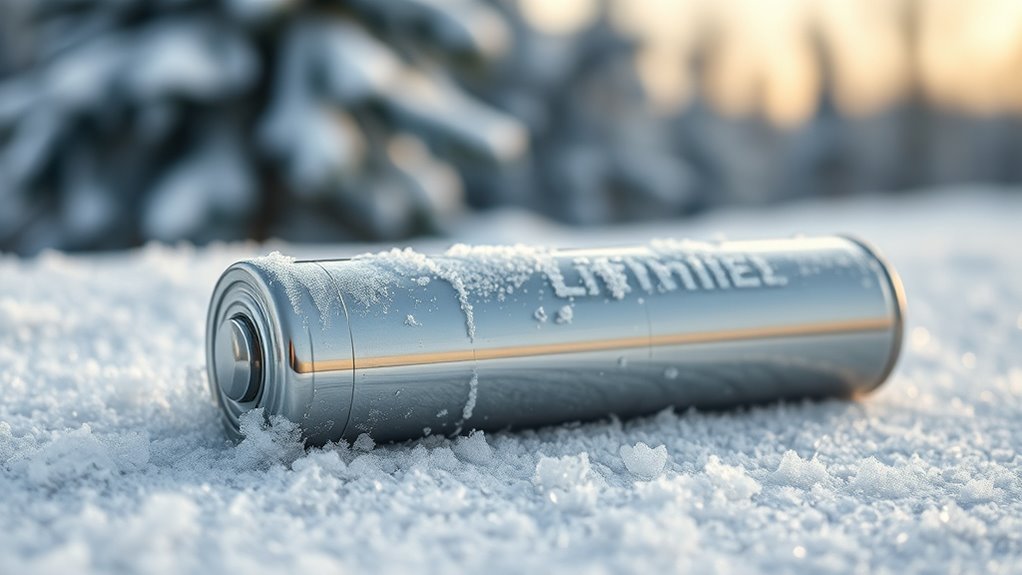
Cold weather considerably impacts lithium battery chemistry by reducing ion mobility within the electrolyte, which in turn diminishes overall performance. This decrease in ion mobility directly affects the battery’s electrochemical stability, as slower ion transport hampers efficient charge and discharge processes. When temperatures drop, the electrolyte’s viscosity increases, limiting ion flow between electrodes. Consequently, the battery’s ability to sustain stable electrochemical reactions weakens, leading to voltage drops and reduced capacity. Understanding these fundamental changes is essential to optimizing battery performance in low temperatures. The diminished ion mobility not only causes immediate performance issues but also accelerates degradation mechanisms, such as solid electrolyte interphase (SEI) layer growth, which further impairs electrochemical stability over time. Addressing these effects requires attention to electrolyte composition and thermal management strategies to mitigate cold-weather impacts.
Why Batteries Lose Power in Winter
During winter, batteries lose power primarily because low temperatures hinder the electrochemical reactions necessary for energy transfer. Cold conditions reduce ion mobility within the battery, leading to decreased voltage output and capacity. Battery insulation plays a vital role in mitigating this effect by minimizing heat loss and maintaining a more stable internal temperature. Without proper insulation, the internal chemistry becomes sluggish, impairing power stabilization. Additionally, colder environments increase internal resistance, causing energy to dissipate as heat rather than useful power. This combination of slowed reactions and heightened resistance explains the rapid power decline in winter. To counteract these effects, effective battery insulation helps sustain consistent electrochemical activity, ensuring better power retention and extending battery usability during cold months.
Simple Tips to Extend Your Battery Life in Cold
To maximize battery performance in low temperatures, implementing simple preventative measures can considerably extend their lifespan. Proper battery insulation is essential; insulating your device or battery compartment minimizes heat loss, maintaining ideal operating temperatures and reducing internal resistance. Additionally, adjusting charging habits is key: avoid frequent top-offs in cold conditions, as rapid charging can induce stress and degrade chemistry. Instead, aim for partial charges and limit deep discharges, which are exacerbated by cold. Storing batteries in warmer environments when not in use also helps preserve capacity. These practices collectively reduce thermal stress, slow capacity fade, and promote more consistent performance. By combining effective insulation with mindful charging routines, we can substantially prolong lithium battery lifespan even in challenging cold climates.
New Cold-Weather Battery Technologies to Watch
Emerging cold-weather battery technologies leverage advanced electrolyte formulations to improve ion mobility at low temperatures, enhancing performance stability. Innovations in thermal management systems aim to maintain ideal operating conditions, reducing capacity loss in frigid environments. Additionally, solid-state batteries are being developed to provide higher energy density and safety, even under extreme cold conditions.
Advanced Electrolyte Formulations
Advancements in electrolyte formulations are vital for developing cold-weather lithium batteries capable of maintaining performance in low temperatures. Researchers focus on improving electrolyte stability to prevent degradation and guarantee consistent ion transport. Conductivity enhancement is achieved through optimized solvent systems and additives that facilitate ion mobility at sub-zero temperatures. These innovations reduce impedance and improve charge/discharge efficiency. The table below illustrates key electrolyte modifications:
| Electrolyte Type | Stability Features | Conductivity Improvements |
|---|---|---|
| Fluorinated Solvents | High thermal stability | Increased ion transfer rates |
| Solid-State Electrolytes | Reduced decomposition | Enhanced low-temp conductivity |
| Additive-Enhanced Electrolytes | Suppress side reactions | Facilitate ion flow at cold |
| Gel Polymer Electrolytes | Mechanical robustness | Maintain conductivity in cold |
| Ionic Liquid Electrolytes | Wide temperature range | Stable ion conduction |
These formulations are essential for resilient cold-weather battery performance.
Thermal Management Innovations
Have recent thermal management innovations truly transformed cold-weather lithium battery performance? Advances in battery insulation and heat retention strategies have considerably improved efficiency by minimizing thermal losses. Modern designs incorporate advanced materials that enhance heat retention, ensuring batteries maintain ideal operating temperatures despite frigid conditions. These innovations enhance internal temperature control, reducing the impact of external cold on electrochemical processes. Improved thermal insulation enables batteries to generate and conserve heat more effectively, thereby decreasing the risk of capacity loss and degradation over time. Additionally, integrated thermal management systems dynamically adjust to temperature fluctuations, further safeguarding battery health. Overall, these developments mark a vital step forward in extending lithium battery lifespan in cold environments, providing more reliable performance and reducing the need for external heating solutions.
Solid-State Battery Development
Since traditional lithium-ion batteries often struggle in cold environments, solid-state battery technology offers a promising alternative by enhancing cold-weather performance. These batteries replace liquid electrolytes with solid electrolytes, increasing energy density and safety. Specifically, they facilitate higher energy density, enabling longer-lasting power sources critical in low temperatures. Additionally, solid-state designs improve thermal stability, reducing degradation and extending lifespan. From a recycling perspective, their simpler architecture simplifies battery recycling processes, potentially reducing environmental impact. Key advancements include:
- Enhanced cold-weather operability due to superior thermal stability.
- Increased energy density leading to longer-lasting batteries.
- Simplified recycling pathways, supporting sustainable battery lifecycle management.
Common Winter Mistakes That Damage Batteries
During winter, exposure to extreme cold and improper handling can accelerate battery degradation, leading to reduced lifespan and performance. One common mistake is neglecting proper battery insulation, which helps maintain a stable temperature and prevents rapid cooling. Without adequate insulation, batteries become vulnerable to cold-induced capacity loss. Additionally, poor charging habits, such as frequent rapid charging or charging at low states of charge, can cause stress on the battery and exacerbate damage in cold conditions. Charging in extremely cold weather may also lead to incomplete charging cycles, further impairing battery health. To mitigate these issues, it’s essential to use appropriate insulation and adopt cautious charging practices, ensuring batteries operate within ideal temperature ranges and reducing the risk of winter-related degradation.
How Manufacturers Are Improving Batteries for Cold Climates
Manufacturers are advancing lithium battery performance in cold climates through the development of specialized electrode materials that retain conductivity at low temperatures. They are also formulating cold-resistant electrolytes to prevent solidification and improve ion mobility, while implementing enhanced thermal management systems to maintain ideal operating temperatures. These innovations collectively extend battery lifespan and reliability in freezing conditions.
Advanced Electrode Materials
Advances in electrode materials are critical for enhancing lithium battery performance in cold climates, where low temperatures substantially impair ionic mobility and overall efficiency. To address this, manufacturers are focusing on improving electrode durability and material stability under harsh conditions. Key innovations include:
- Incorporating nanostructured electrode materials to increase surface area and facilitate ion transport.
- Developing composite materials that resist mechanical degradation during charge-discharge cycles.
- Utilizing doped electrodes to enhance electrical conductivity and stability at low temperatures.
These strategies aim to mitigate capacity loss and extend battery lifespan in cold environments. By enhancing electrode durability and ensuring material stability, we can maintain efficient ion flow and reduce degradation, ultimately improving overall battery performance in challenging climates.
Cold-Resistant Electrolytes
To effectively operate lithium batteries in cold climates, developing electrolytes that maintain ionic conductivity at low temperatures has become a critical focus. Researchers are enhancing electrolyte stability to prevent solid electrolyte interphase (SEI) degradation, which hampers performance in cold conditions. Conductivity enhancement is achieved through the formulation of low-temperature electrolytes that incorporate additives or solvents with favorable dielectric properties, ensuring ions move efficiently despite low thermal energy. These innovations enable batteries to sustain charge transfer processes, reducing capacity loss and improving overall lifespan. By optimizing electrolyte composition, manufacturers address the inherent challenges posed by cold environments, leading to improved electrochemical stability and consistent performance. This targeted approach is essential for expanding lithium battery applications in winter conditions, ensuring reliability and longevity in cold weather operations.
Enhanced Thermal Management
How do we guarantee lithium batteries perform reliably in cold climates? Enhanced thermal management is key. Manufacturers focus on improving heat retention through advanced battery insulation, which minimizes heat loss and sustains ideal operating temperatures. These improvements enable batteries to resist cold-induced performance degradation. We emphasize three critical strategies:
- Refined insulation layers to reduce thermal conductivity.
- Integrated heating systems that activate when temperatures drop below threshold.
- Material innovations that enhance heat retention and resist thermal fatigue.
Frequently Asked Questions
How Does Temperature Specifically Impact Lithium-Ion Battery Capacity Over Time?
Temperature causes thermal effects that directly impact lithium-ion battery capacity, leading to capacity reduction over time. Cooler conditions slow chemical reactions, decreasing efficiency, while higher temperatures accelerate degradation, emphasizing the importance of ideal thermal management for longevity.
Are There Specific Brands Known for Better Cold-Weather Battery Performance?
Think of battery brands as seasoned sailors steering icy waters; brands like Panasonic, Samsung, and LG are renowned for superior cold weather performance, demonstrating consistent capacity retention and resilience in low temperatures, making them reliable choices for frigid conditions.
Can Storing Batteries at Room Temperature Prolong Their Lifespan in Winter?
Storing batteries at room temperature, combined with proper battery insulation and cold storage methods, can considerably prolong their lifespan in winter by minimizing thermal stress, reducing capacity loss, and maintaining ideal chemical stability within their cells.
What Are the Environmental Impacts of Cold-Weather Battery Degradation?
Cold-weather battery degradation acts as a double-edged sword, worsening environmental pollution through increased waste and recycling challenges, as deteriorated batteries release harmful chemicals. We must address these issues to mitigate ecological impacts effectively.
Do All Types of Lithium Batteries React the Same Way to Cold Temperatures?
Not all lithium batteries react the same way to cold weather; their response depends on battery chemistry. Lithium-ion, lithium-polymer, and other types exhibit varied performance declines, with some more resilient due to specific electrolyte and electrode material properties.
Conclusion
In summary, while cold weather relentlessly sabotages lithium batteries through sluggish chemistry and increased resistance, our best bet is to keep pretending that insulation and advanced materials are magic bullets. As manufacturers innovate, we can hope for batteries that shrug off winter’s icy grip. Until then, understanding these limitations helps us avoid catastrophic failures—because nothing screams “smart” like planning ahead for a cold snap, rather than blaming the device when it refuses to cooperate.